
Property Tax for Housing Societies: A Practical Guide for RWA Committees
Property tax is not the same liability as income tax or GST on maintenance, and confusing the three is where most committee mix-ups start. How municipal property tax actually applies to a housing society, and what a committee should keep on record.
Why property tax gets tangled up with other society taxes
Ask a managing committee about "society tax" and the conversation usually drifts between three completely different liabilities — income tax on the RWA's own income, GST on maintenance charges above certain thresholds, and property tax on the building and land itself. The first two depend on what the society collects and earns. Property tax is different: it is a municipal levy on the property, assessed by the local urban local body (ULB) or municipal corporation, and it applies regardless of whether the society runs a surplus, a deficit, or breaks even for the year. Committees that treat all three as one blurry "society tax" bucket are the ones most likely to get a bill wrong or miss a deadline.
This is general guidance on how property tax typically applies to housing societies and apartment owners in India. Municipal property tax rules, valuation methods, rates, and billing processes are set locally — by the state and the specific municipal corporation — and vary significantly between cities. Treat this as a starting point for confirming the specifics with your society's own municipal corporation and a chartered accountant, not as a substitute for either.
How municipal bodies actually calculate it
Indian municipalities generally use one of three valuation approaches, and which one applies depends entirely on the city:
- **Annual Rental Value (ARV) / Ratable Value system** — tax is based on the estimated annual rent the property could fetch, regardless of whether it is actually rented out
- **Capital Value System (CVS)** — tax is based on the market value of the property, as per the municipal corporation's own valuation, multiplied by a prescribed rate
- **Unit Area Value (UAV) system** — tax is based on a per-unit-area rate that factors in location, usage, age, and type of construction, multiplied by the built-up or carpet area
A society's own bill will reference whichever system its municipal corporation uses, and the exact formula, applicable rate, and any rebates (for self-occupied units, senior citizens, or older buildings, for example) differ by city and sometimes by ward within the same city. There is no single national formula a committee can rely on.
Who the bill is actually addressed to
This is where societies most often get confused, because the answer has changed over time in some cities and varies by locality in others:
- In many municipalities, the corporation issues **one consolidated property tax bill to the society**, covering the entire building or plot, and the society is then responsible for apportioning and collecting the amount from individual flat owners before remitting it
- In other cities — Mumbai is a well-known example — municipal bodies have moved toward **individual, flat-wise property tax bills** issued directly to each owner once the building has an Occupancy Certificate, rather than one bulk bill to the society
- Property tax on **unsold flats and common areas still held by the builder or developer** is generally the builder's liability until those units are transferred, not the society's — but the society still needs to confirm this is actually being paid, since an unpaid builder liability can complicate the account status of the whole property
- Whichever system applies locally, the committee should confirm in writing with the municipal corporation which structure it is under, rather than assuming last year's process still holds
Common mistakes societies make
- Conflating property tax with income tax or GST when discussing "society tax" at a general body meeting, which leads to incorrect assumptions about what is actually due and when
- Continuing to collect and remit a consolidated bill on behalf of members after the municipal corporation has switched the building to individual, flat-wise billing — or the reverse, assuming individual billing when the society is still the one on the hook
- Missing the exemption or rebate a member is entitled to (self-occupied status, senior citizen concession, or an early-payment discount) simply because nobody checked what the local corporation currently offers
- No clear record of whether the builder has cleared property tax dues on unsold inventory before those units were handed over to the society
- Letting property tax notices or demand letters sit unopened in a committee member's inbox until a penalty or interest charge has already accrued
What a defensible property tax record should include
- A copy of the current property tax bill or assessment, along with the valuation method and any rebates applied, kept somewhere the next committee can find it
- A clear, written answer to whether the municipal corporation bills the society in bulk or bills individual flat owners directly, confirmed with the corporation rather than assumed
- A record of payment dates and receipts for every cycle, since late payment usually triggers interest or penalty charges set by the local body
- Documentation of the builder's property tax status on any unsold or unhanded-over units at the time of society registration or building handover
- A note of the payment due dates and any rebate windows (many municipalities offer a discount for early or full-year payment), so the society is not defaulting to the most expensive payment option out of habit
How MySocietyEntry helps
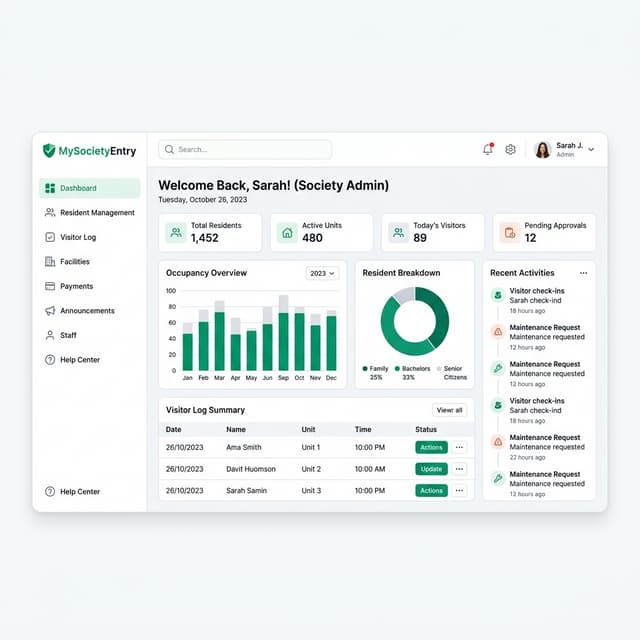
MySocietyEntry does not assess, calculate, or file property tax — that stays with the municipal corporation and, depending on the local billing structure, the society or the individual flat owner. Where the platform helps is in keeping the surrounding record straight: property tax payments the society makes on members' behalf can be logged and tracked through the same expense and vendor records used for every other society outflow, receipts and assessment documents can be attached to that record instead of sitting in someone's email, and if the committee needs to show what was paid, when, and against which assessment, that history is in one place rather than reconstructed from old bank statements every time a member or auditor asks.
Final takeaway
Property tax is not the same liability as income tax or GST, and the biggest risk for most committees is not the tax itself but confusing which of the three applies, who it is billed to, and when it is due. A committee that confirms its municipal corporation's current billing structure, keeps assessment and payment records in one place, and does not let a notice sit unread is in a far stronger position than one relying on what "used to be true" a few years ago.
See It In Action
Explore Society Accounting Software
MySocietyEntry helps committees turn guidance like this into a working process instead of another spreadsheet.
Society Accounting Software