
Annual Statutory Audit for Housing Societies: A Practical Guide for RWA Treasurers
The audit a housing society is legally required to complete every year is a different exercise from a structural audit or an income tax audit — what it actually covers, who can be appointed, and what a committee should have ready before the auditor arrives.
Three different "audits" housing societies confuse with each other
Committees regularly use the single word "audit" for three unrelated exercises: a structural audit of the building's physical condition, an income tax audit tied to a society's taxable income crossing a threshold, and the annual statutory audit of the society's accounts that most registered co-operative housing societies must complete every year regardless of income, surplus, or building age. This guide is about the third one — the recurring financial audit tied to a society's registration under its state's co-operative societies act, not the engineering inspection or the tax-specific audit.
This is general guidance on how the annual statutory audit typically works for registered housing societies in India. The exact provisions — which section of which act applies, the deadline relative to the financial year, who is eligible to be appointed, and what the audit report format must contain — are set by each state's co-operative societies act and rules, and differ enough between states that a committee should confirm the specifics with its registrar's office and a chartered accountant rather than assume last year's process still applies.
What makes this audit different from the others
- A **structural audit** examines the physical condition of the building — the RCC structure, seepage, load-bearing elements — and is an engineering exercise, typically required at defined building-age intervals or after a municipal notice, not an annual financial requirement
- An **income tax audit** under the Income Tax Act only applies once a society's taxable turnover or receipts cross a statutory threshold, and is separate from the co-operative audit even when the same chartered accountant happens to perform both
- The **annual statutory audit** under a state's co-operative societies act applies to the society's books of account — income, expenditure, funds, and compliance with the act's financial provisions — and is generally mandatory every year for every registered society, independent of its size or financial position
- Most state co-operative acts also require the audited accounts, along with the auditor's report, to be placed before the Annual General Meeting for member approval, which is why audit timing and AGM timing are usually planned together rather than as two separate deadlines
Who is generally eligible to be appointed
- Many state co-operative frameworks maintain a **panel of approved auditors** — often called certified or departmental auditors — from which societies are required or encouraged to appoint their statutory auditor, rather than engaging any practicing chartered accountant freely
- Some states allow a society to appoint its own chartered accountant subject to conditions, while others route appointment through the registrar's office or a departmental audit system; which model applies is entirely state-specific
- Auditor rotation rules, where they exist, are also set at the state level — some frameworks limit consecutive terms for the same auditor, others do not address rotation at all
- The appointment or reappointment of the statutory auditor is typically itself an agenda item requiring member approval at the AGM, which means a committee that skips this resolution can end up with an audit conducted by an auditor who was never formally approved by the general body
What the auditor typically reviews
- Income and expenditure records against the society's approved budget and any resolutions authorizing non-routine spending
- Maintenance bill generation and collection records, matched against the ledger and bank statements
- Sinking fund, repair fund, and any other statutory reserve accounts, checked for whether contributions match the rates the act or the society's bye-laws require
- Vendor payments, AMC contracts, and supporting bills for expenditure above whatever threshold the society's own financial rules or bye-laws set for requiring quotations or committee approval
- Compliance items the co-operative act ties to the audit — such as whether statutory registers are maintained, whether required resolutions were passed for major expenditure, and whether previous audit objections were addressed
- Bank reconciliation and cash-in-hand verification, along with confirmation that fixed deposits and investments are recorded and renewed correctly
Common mistakes committees make
- Treating a structural audit, an income tax audit, and the statutory co-operative audit as one undifferentiated "audit season," which leads to missed deadlines on whichever one gets least attention
- Appointing an auditor without a formal AGM resolution, then discovering the appointment is not recognized when the audited accounts are filed or challenged
- Handing the auditor a shoebox of receipts and bank statements a week before the deadline instead of maintaining reconciled books through the year, which turns a routine audit into a reconstruction project
- Letting the previous year's audit objections or qualifications sit unaddressed, so the same findings repeat — and sometimes compound — year after year
- Not filing the audited accounts and auditor's report with the registrar's office within the timeline the state act requires, treating the AGM presentation as the final step when a separate filing obligation often still applies
What a defensible audit record should include
- A formal AGM resolution appointing or reappointing the statutory auditor for the year, before the audit begins
- Reconciled books of account, updated through the year rather than assembled retroactively, so the audit is a verification exercise rather than a bookkeeping catch-up
- A written response to every objection or qualification raised in the previous year's audit report, showing what was corrected and when
- Copies of the signed audit report and the AGM minutes recording that the audited accounts were placed before members, stored somewhere the next committee can find without depending on whoever was treasurer that year
- Confirmation, in writing, of whether the audited accounts and report were filed with the registrar's office within the applicable deadline, and a copy of that filing acknowledgment
How MySocietyEntry helps
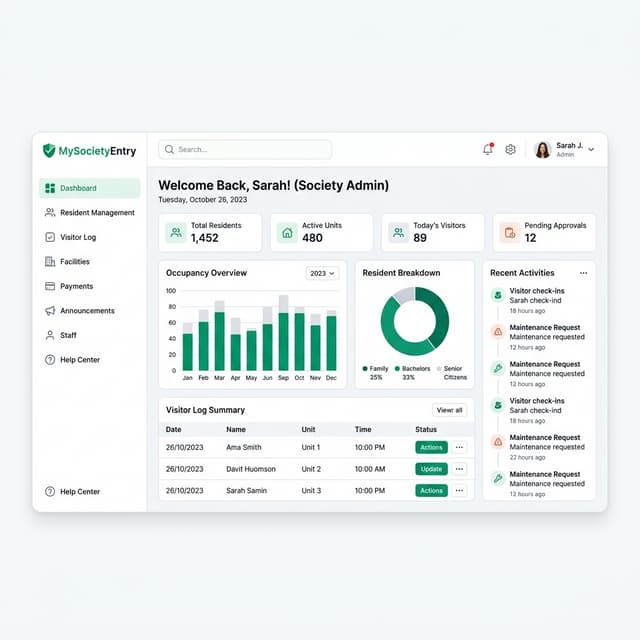
MySocietyEntry does not conduct the statutory audit itself — appointing an eligible auditor and responding to their findings stays a committee and auditor responsibility under the applicable state act. Where the platform helps is in keeping the underlying records audit-ready through the year rather than reconstructed at the end of it: maintenance billing, collections, and dues sit on one ledger; expense and vendor payments are logged with supporting bills attached instead of scattered across email and paper folders; and sinking fund or other reserve contributions are tracked separately so an auditor can verify them against the rate the bye-laws require without the treasurer rebuilding a year of transactions from bank statements first.
Final takeaway
The annual statutory audit is not optional, is not the same exercise as a structural or income tax audit, and works far better as a year-round bookkeeping discipline than as a once-a-year scramble. A committee that appoints its auditor through a proper AGM resolution, keeps reconciled records through the year, and actually closes out the previous year's objections turns the audit into routine confirmation rather than an annual source of disputed findings.
See It In Action
Explore Society Accounting Software
MySocietyEntry helps committees turn guidance like this into a working process instead of another spreadsheet.
Society Accounting Software