
Preventing Payment Fraud and Vendor Impersonation in Housing Societies: A Guide for RWA Committees
Why treasurers and committee members handling recurring vendor payouts and corpus funds are a growing target for impersonation and bank-detail scams, and the approval controls that close the gap.
Why RWA treasurers are an attractive target
A housing society treasurer or committee member handling accounts sits on exactly the profile fraudsters look for: authority to move money, a rotating cast of vendors whose bank details change often enough that a change request does not look unusual, and approvals that frequently happen over a phone call or a WhatsApp message rather than through a documented process. Indian courts and police have also seen the inverse problem — office bearers themselves booked for misappropriating society funds collected as maintenance or corpus. Both risks are addressed by the same fix: payments that move only through a documented, verifiable approval trail, not a committee member's word or a message thread.
Common patterns to watch for
- An email or message, apparently from a regular vendor, asking the society to update the bank account for future payments — often timed right before a large AMC or contractor invoice is due
- A message that appears to be from the secretary or treasurer, sent from an unfamiliar number, asking a committee member or accountant to urgently release a payment or share an OTP
- A QR code at a collection point or notice board that has been altered or replaced, so a resident's maintenance payment goes to the wrong account
- An invoice that looks legitimate but does not match any active AMC, work order, or purchase approval the committee actually issued
- Pressure to bypass the usual approval step because the request is framed as urgent, time-sensitive, or from someone senior in the committee
Controls that close the gap
- Never change a vendor's bank details on the basis of an email or message alone — confirm the change by calling the vendor back on a number the society already has on file, not one included in the request
- Require a second person's sign-off before any payment above a set threshold is released, so no single individual — inside or outside the society — can move money alone
- Match every invoice against an active AMC, work order, or committee-approved purchase before payment, rather than paying on the invoice's word
- Treat "urgent, approve now" requests as a reason to slow down and verify, not a reason to skip the usual process
- Keep vendor bank details, contracts, and payment history in one system of record that shows who approved what and when, instead of scattered across emails, chats, and a treasurer's memory
Why this protects the committee too
A documented approval trail is not only a defense against outside fraud — it is also the clearest way for honest committee members to show their own conduct was above board. A society that can produce, for any payment, the invoice, the matching work order, and the approver's name has already answered the questions an audit or an unhappy resident is most likely to raise. A society that cannot is vulnerable to suspicion even when nothing was actually wrong.
What committees commonly get wrong
- Letting one signatory — often the treasurer, sometimes a managing agent — approve and release payments without a second check, because it is faster
- Approving vendor bank-detail changes over WhatsApp because the message appears to come from a known contact
- Reusing the same UPI QR code for years without checking it against the account it was originally generated for
- Assuming a professionally formatted invoice is proof enough that the underlying work or purchase was actually approved
- Discovering a mismatched payment only at the next audit, by which point recovering the money is far harder than preventing it would have been
How MySocietyEntry helps
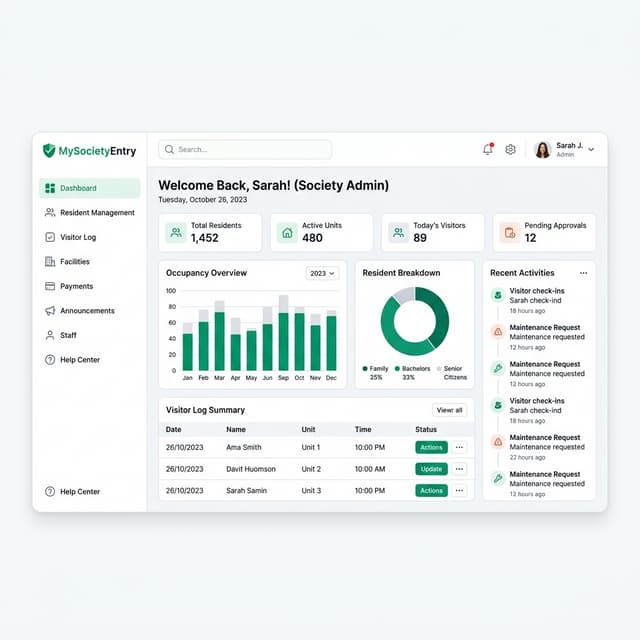
MySocietyEntry's accounting module keeps vendor records, AMC and work-order details, and payment approvals in one place instead of spread across emails and chat threads. Every payout runs through the vendor register and expense approval workflow, so a committee can see who requested a payment, what it was matched against, and who approved it before it went out — a record that stands up at audit time and makes an unusual request easier to catch before money moves, not after.
Final takeaway
Payment fraud aimed at housing societies rarely relies on a sophisticated technical attack — it relies on a request that looks urgent enough, or familiar enough, to skip the usual verification step. A committee that requires a callback before honoring any bank-detail change, a second sign-off before release, and an invoice that matches an actual approval closes off nearly every version of the scam, while also giving its own office bearers a clean record to stand on.
See It In Action
Explore Society Accounting Software
MySocietyEntry helps committees turn guidance like this into a working process instead of another spreadsheet.
Society Accounting Software