
Legal Recovery of Unpaid Maintenance Dues: A Process Guide for Housing Societies
What happens after reminders and notices fail — the formal recovery routes available to a registered housing society, where they differ from internal defaulter follow-up, and the paper trail a committee needs before filing anything.
When internal follow-up stops being enough
Most maintenance defaults resolve at the reminder-and-notice stage covered in a society's day-to-day defaulter tracking. A smaller number do not — a flat owner disputes the amount, ignores every notice, or leaves the unit vacant and unreachable while dues keep accumulating. At that point, an RWA committee is no longer managing a follow-up process; it is deciding whether to initiate a formal recovery proceeding, and that decision has to rest on a documented history the committee can actually produce, not on how frustrated the treasurer is.
Where the legal route differs by society type
- A cooperative housing society registered under its state's Cooperative Societies Act typically has access to a Registrar-based recovery mechanism and a dedicated cooperative court or tribunal for member disputes, including maintenance recovery — this is the route most Indian RWAs eventually rely on, and Maharashtra's framework (recovery certificates under the Maharashtra Cooperative Societies Act, and disputes before the Cooperative Court) is a commonly cited example, though the specific sections, forum names, and timelines differ from state to state
- An apartment owners' association registered under a state Apartment Ownership Act, or a society registered under the Societies Registration Act rather than a cooperative act, generally does not have access to the same Registrar/cooperative-court mechanism and instead has to pursue recovery through a civil suit or, in some cases, a consumer forum, which is typically slower
- A few states have introduced faster, streamlined recovery provisions specifically for housing society dues in recent years, alongside the older, more cumbersome civil-suit-style route — which mechanism applies, and how it is invoked, depends entirely on your state's current cooperative societies legislation
- Because the applicable law and forum depend on how your society is registered and which state it is in, the starting point before any formal filing should always be confirming the correct route with a lawyer familiar with cooperative or society law in your state, not assuming a process reported for a different state or a different type of society applies to yours
What courts have generally recognised
- Maintenance and service charges are usually treated as a recurring, continuing obligation rather than a one-time debt, which is why courts have generally been reluctant to let a defaulting member escape old dues purely on a limitation-period argument — every month of non-payment has been treated as creating a fresh cause of action in several rulings
- Bye-laws that provide for interest on overdue maintenance are generally enforceable, so long as the rate is what the society's registered bye-laws actually specify and has been applied consistently rather than selectively
- A change of ownership does not automatically wipe out dues owed by the previous member — courts have in several instances held an incoming owner, including an auction purchaser, responsible for clearing outstanding society dues before being admitted as a member
- None of this is a substitute for legal advice on a specific case — cited principles establish a general direction, not a guaranteed outcome, and a committee should still have its own lawyer confirm how a particular ruling applies before relying on it in a filing
What to have in place before filing anything
- A complete, dated log of every reminder, notice, and response for the flat in question — the exact escalation trail the society's own bye-laws describe, not an informal record of phone calls
- The bye-law clause or AGM resolution that establishes the interest rate or late fee being claimed, since a forum will expect the claimed amount to trace back to something the society actually adopted and communicated
- A flat-wise statement of account showing the opening balance, every charge raised, every payment received, and the running outstanding balance — reconciled against the bank statement, not just the ledger
- Proof that the standard escalation steps in the bye-laws were followed and exhausted before the committee decided to file, since most forums expect internal remedies to have been attempted first
- A committee or AGM resolution authorising the recovery filing, since an office-bearer acting without one can leave the filing open to a procedural challenge
What committees commonly get wrong
- Approaching the Registrar or cooperative court with an incomplete or undated paper trail, which is the single most common reason a straightforward recovery claim gets delayed
- Cutting off water, electricity, or other essential services to pressure a defaulter — most bye-laws and consumer protection rules do not permit this, and it can turn a society with a legitimate recovery claim into the respondent in a separate complaint
- Applying interest or a penalty that was never formally adopted in the bye-laws or an AGM resolution, which weakens an otherwise valid claim the moment it is questioned
- Letting a change in committee reset institutional memory, so a new treasurer inherits a stalled case with no clear record of what was already filed, notified, or agreed
- Treating the legal route as a first step rather than a last one — most forums, and most committees' own bye-laws, expect the standard reminder-and-notice escalation to be attempted and documented first
How MySocietyEntry helps
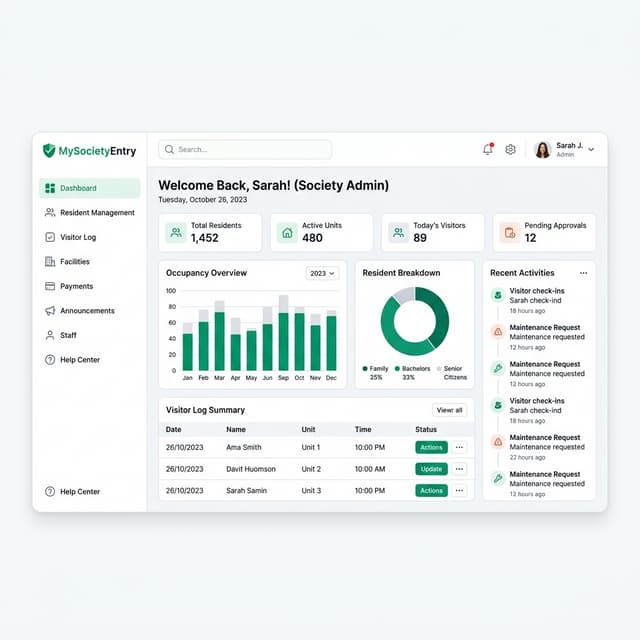
MySocietyEntry does not file recovery cases or provide legal representation — that stays with the society's appointed advocate and the relevant Registrar or court. What the platform does is keep the record a lawyer or forum will actually ask for in one place: a flat-wise ledger that reconciles automatically as payments are recorded, a dated log of every reminder and notice sent through the defaulter tracking workflow, and bye-law-based interest applied consistently instead of calculated by hand. When a case does reach the point of formal recovery, the committee is producing an export from a system of record instead of reconstructing a timeline from old emails and a treasurer's memory.
Final takeaway
Legal recovery of maintenance dues is rarely lost on the merits of the claim — a society is almost always owed what it says it is owed. It is lost, or delayed for years, on process: an incomplete paper trail, an interest rate nobody can point to a resolution for, or a filing made without exhausting the bye-laws' own escalation steps first. A committee that keeps its defaulter records complete and current from day one is the one that can actually use the legal route when reminders and notices run out, instead of discovering the gaps only after a case is already filed.
See It In Action
Explore Society Accounting Software
MySocietyEntry helps committees turn guidance like this into a working process instead of another spreadsheet.
Society Accounting Software