
Delivery and Parcel Management in Housing Societies: A Practical Guide for RWA Committees
Why the daily volume of e-commerce and food deliveries has become a real gate management and security problem for apartment communities, and what a workable delivery policy should actually cover.
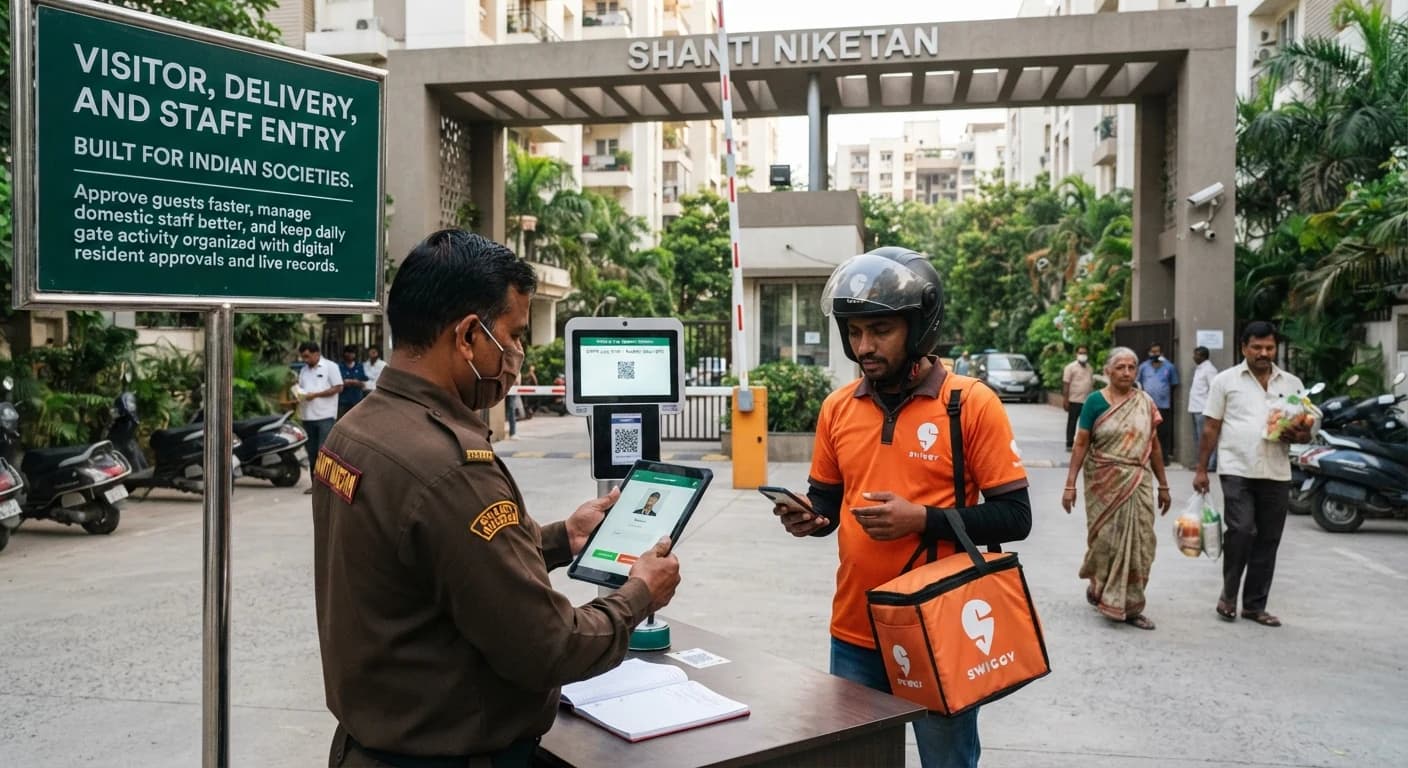
Why deliveries have become a gate management problem, not a visitor one
Most housing society gate processes were designed around the idea of a visitor: someone arriving, being announced, and either being let in or turned away. Delivery and pickup traffic does not fit that model well. A single mid-sized apartment community can see dozens of e-commerce, food, grocery, and courier arrivals a day, spread across every delivery platform operating in the area, each with its own rider, its own app, and no relationship with the resident beyond a phone number. Treating this volume with the same manual process used for a personal guest — a phone call to the flat, a wait at the gate, a name written in a register — is what actually causes the gate backlog committees complain about, far more than genuine visitor traffic does.
The result is a security and operations problem hiding inside what looks like a convenience issue. Guards under pressure from a queue of riders start waving deliveries through without verification. Residents who are not home have no clean way to authorize a handoff, so parcels get left at the gate, with a neighbour, or not delivered at all. And when something does go wrong — a parcel goes missing, or someone claiming to be a delivery rider gets further into the premises than they should have — there is usually no searchable record of who came in, for which flat, and at what time.
What makes delivery traffic different from a regular visitor
- High frequency and low individual risk per rider, which pushes guards toward shortcuts that would not be acceptable for a personal visitor
- No pre-existing relationship between the resident and the specific rider, unlike a guest the resident actually invited
- A need to sometimes complete the handoff without the resident present, since many deliveries arrive when nobody is home
- Multiple platforms and aggregators operating in the same community, each with different rider verification standards that the society has no control over
- Cash-on-delivery and high-value parcels that carry more risk than a routine grocery drop, without the gate process distinguishing between the two
Where committees commonly get the policy wrong
- No policy at all, so each guard shift handles deliveries differently and enforcement depends entirely on who is on duty
- A blanket rule requiring every delivery rider to be personally received at the gate by the resident, which sounds secure on paper and in practice gets ignored the moment there is a queue, because it is not realistic for a household to come down for every parcel
- Deliveries logged, if at all, in the same paper register as visitors, mixed in with guest entries and impossible to search later by flat or by date
- No process for a resident to pre-authorize a delivery they are expecting, so every rider still has to be individually confirmed by phone even for routine, scheduled orders
- Common areas — lobby tables, the space near the lift, the security cabin — used as an informal parcel drop zone with no log of what was left there or when it was collected
What a workable delivery policy should cover
- A gate entry category for deliveries that is separate from personal guests, so guards follow a distinct, faster verification step suited to the actual risk (rider ID and order confirmation, not a full visitor interview)
- A way for residents to notify the gate in advance that a delivery is expected, so routine orders do not require a phone call to the flat every time
- A clear rule for what happens when the resident is not home: whether the rider waits, whether a specific common-area drop point is used, and who is accountable for a parcel left there
- A dated, searchable record of delivery entries by flat, separate from the general visitor log, so a missing-parcel dispute can actually be investigated instead of relying on a guard's memory
- Guidance for guards on higher-risk situations — a rider asking to go beyond the gate or lobby, a cash-on-delivery parcel, or someone claiming to be a delivery agent without a visible platform uniform or ID — that does not depend on the guard's individual judgment alone
How MySocietyEntry helps
MySocietyEntry's gate workflow treats delivery and pickup traffic as its own entry type rather than folding it into general visitor logging. Riders can be checked in against a category built for delivery volume, residents can pre-approve an expected order from the resident app so the gate does not have to call up for every routine delivery, and every delivery entry is logged with a timestamp against the specific flat — searchable later if a parcel goes missing or a resident asks when something arrived. That does not remove the judgment calls a guard has to make at the gate, but it does mean the society has an actual record to check instead of relying on memory, and residents get a faster, less disruptive process for the deliveries they are expecting anyway.
Final takeaway
Delivery traffic is not going away, and treating it as an afterthought to visitor management is what actually produces the gate delays and unaccountable parcel handoffs committees end up fielding complaints about. A society that gives deliveries their own entry category, lets residents pre-authorize expected orders, and keeps a separate, searchable log ends up with both a faster gate and a far easier time investigating the rare case that does go wrong.
See It In Action
Explore Apartment Security App
MySocietyEntry helps committees turn guidance like this into a working process instead of another spreadsheet.
Apartment Security App