
Deemed Conveyance: What It Means for a Housing Society Without a Conveyance Deed
Why a large number of older housing societies still do not legally own the land their building stands on, what deemed conveyance is as a remedy, and the process a committee should expect if it has to use it.
Why so many societies never actually received their land title
A housing society is meant to receive title to the land and building it occupies from the builder or promoter once the society is registered and flats are sold. In practice, a very large number of older societies — particularly in Mumbai and the rest of Maharashtra — never received that conveyance. Builders sometimes delay it deliberately, hoping to hold on to additional Floor Space Index (FSI) or development rights that might become available later, and sometimes it is simple negligence: the builder has moved on to other projects and there is no one left actively following up. Either way, the result is the same — a society that has been running its own affairs for years, or decades, without actually owning the ground its building stands on.
This matters far more than it looks like it should on paper. A society without a conveyance deed cannot mortgage its property cleanly, cannot undertake redevelopment with full legal confidence, and cannot claim transferable development rights (TDR) that may be available on its own plot. Deemed conveyance exists as a legal remedy for exactly this situation, but it is a formal process with its own paperwork, timelines, and jurisdictional limits — not something a committee can complete with a single application and a wait.
This article covers deemed conveyance as it exists under Maharashtra's cooperative and ownership-flats framework, since that is where the remedy is most developed and most commonly used. Societies in other states should confirm with a local lawyer or their state's cooperative department whether an equivalent mechanism exists there, rather than assume this process transfers as-is.
Conveyance versus deemed conveyance
A conveyance deed is the document a builder or promoter is supposed to execute voluntarily, transferring title of the land and building to the housing society (or to the apex body, in a layout with multiple societies) once the project is complete and the society is formed. Deemed conveyance is what a society can pursue when that voluntary transfer never happens: an amendment to Section 11 of the Maharashtra Ownership Flats Act, 1963 lets the society approach a Competent Authority — typically the District Deputy Registrar of Co-operative Societies — and obtain conveyance unilaterally, without needing the builder's cooperation or signature.
The two produce the same practical outcome, legal title in the society's name, but deemed conveyance is inherently an adversarial-adjacent process. It exists because the normal, cooperative route did not work.
What the process generally involves
- An application, commonly referred to by its form number, filed with the Competent Authority along with the required court fee and supporting documents — the society's registration certificate, the agreement for sale copies, the layout and building plans, and proof that requests to the builder for voluntary conveyance were made and did not result in one
- A notice to the builder or promoter and other interested parties, followed by a hearing before the Competent Authority where the society has to establish its case
- A decision from the Competent Authority directing the conveyance, which the society then has to get formally registered like any other property document, since the order itself is not a substitute for registration
- A process that is designed to move within a defined window once filed, but that in practice depends heavily on how complete the society's documentation is, whether the builder or other parties contest it, and how backlogged the specific registrar's office is
Every one of these steps has specific documentary and procedural requirements that go well beyond what a general article can responsibly summarize, and errors in the application are a common reason cases stall for years. A society considering this route should engage a lawyer with specific deemed-conveyance experience, ideally one who can point to cases they have actually taken through to registration, rather than attempt the filing on committee volunteer time.
Why committees often discover this late
- The society has been functioning normally for years — collecting maintenance, holding elections, running AGMs — and the absence of a conveyance deed only surfaces when a bank asks for it during a loan application, or when redevelopment conversations begin and a lawyer asks to see the title documents
- Successive committees assumed a previous committee had "handled" the conveyance, because it was never flagged as outstanding in any handover
- The share certificates and the original agreement for sale exist, but nobody can locate a complete, organized set of the layout plans, occupation certificate, and correspondence with the builder that a deemed conveyance application actually requires
- A society assumes conveyance is only relevant if redevelopment is being planned, when in reality it also affects the society's ability to raise a loan against the property, respond to municipal or FSI-related notices, and defend its title if a dispute arises
What a committee can do before it needs a lawyer
- Check the society's own records — the conveyance deed, if any, is usually referenced in the original documents provided at the time of possession, or should have been registered and would appear in a title search at the sub-registrar's office
- If no conveyance exists, start assembling the documentation a deemed conveyance application will eventually need: the registration certificate, agreement for sale copies for as many flats as can be gathered, layout and building approval plans, occupation certificate, and any written correspondence ever sent to the builder requesting conveyance
- Raise it as a standing item at the AGM so it has a documented history of committee attention, rather than being an informal, undocumented concern that gets dropped every time the committee changes
- Get a preliminary opinion from a lawyer with deemed-conveyance experience before committing significant society funds to the process, since case strength depends heavily on how much of the above documentation the society can actually produce
How MySocietyEntry helps
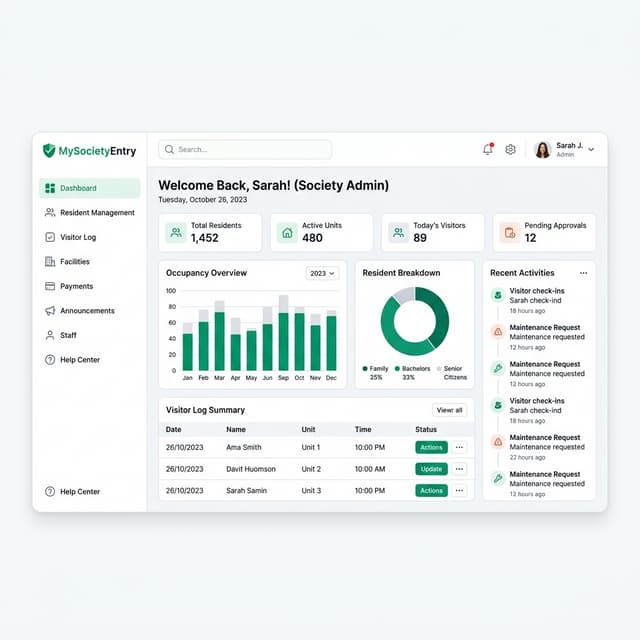
Deemed conveyance itself is a legal filing that has to go through a Competent Authority and, ultimately, a lawyer — a society operations platform has no role in that process directly. Where MySocietyEntry helps is in making sure the society isn't starting from zero when that process does begin: the resident and society records the platform already holds — registration details, past AGM minutes and resolutions, and a running archive of committee notices and correspondence — give a committee a documented history to draw on instead of reconstructing years of activity from memory. That does not replace the specific title documents a lawyer will need to gather, but it does mean the society's own governance record is not one more thing that has to be pieced together under pressure.
Final takeaway
A missing conveyance deed rarely causes a problem on a normal operating day, which is exactly why it stays unresolved for years — right up until a bank, a builder, or a redevelopment opportunity asks for a title document the society cannot produce. Checking now whether your society actually holds a conveyance deed, and starting to assemble the supporting documents if it doesn't, costs a committee very little today. Discovering the gap mid-negotiation, with a bank or developer waiting on an answer, costs a great deal more.
See It In Action
Explore Society Management Software
MySocietyEntry helps committees turn guidance like this into a working process instead of another spreadsheet.
Society Management Software