
Statutory Registers and Records Every Housing Society Must Maintain
The registers and records a cooperative housing society is expected to keep on file year-round, why "we will pull it together for the audit" is the mistake that causes most adverse findings, and what a defensible record-keeping setup looks like.
Why "we'll sort the registers before the audit" is the wrong plan
Every housing society's statutory audit report has a line, usually near the end, that lists which registers and records were produced for inspection and which were incomplete, out of date, or missing entirely. Committees that treat this as a formality tend to discover otherwise: a missing nomination register becomes a real problem the day a member passes away and the family needs to establish who was nominated, and a minutes book with gaps becomes a real problem the day a resolution is challenged and nobody can produce the record of it being passed. Registers are not paperwork kept for the auditor's benefit. They are the society's own evidence of who its members are, what has been decided, and what it owns — and they only work if they are updated as things happen, not reconstructed once a year.
This is general guidance on the categories of registers and records that registered cooperative housing societies in India are commonly expected to maintain. The exact list, its numbering, and the specific bye-law or section that requires each one are set by each state's cooperative societies act and its model bye-laws, and differ enough between states that a committee should confirm the current, complete list with its registrar's office or a society consultant rather than treat this article as that list.
Why this sits with the secretary, not just the treasurer
Record-keeping in a housing society is usually described as a secretarial responsibility, distinct from the treasurer's accounting records, even though the two overlap in places (a defaulter register, for instance, is as much a financial record as a governance one). Committees that assign every record-keeping task to whoever is treasurer that year tend to leave the non-financial registers — membership, nominations, minutes — unmaintained, because no one owns them specifically. A workable setup names who is responsible for which register, independent of who happens to hold which office in a given term.
The broad categories most societies need to keep current
- **Membership and governance records** — a register of members with flat-wise details, a nomination register recording who each member has nominated and when, and a minutes book capturing managing committee and general body meeting resolutions with dates and attendance
- **Share and transfer records** — the society's share register, along with a log of share certificate transfers whenever a flat changes ownership, cross-referenced with the transfer fee and NOC records described in a resale
- **Financial and billing records** — beyond the books of account an auditor reviews directly, a defaulter register tracking members with overdue maintenance, and a bill or demand register showing what was billed and when
- **Property and asset records** — records of the society's own property (common areas, equipment, fixed assets) and any investments or fixed deposits held in the society's name
- **Correspondence and complaint records** — a dated log of complaints raised by members and how each was resolved, and copies of notices issued to members or received from the registrar's office
Where this most often breaks down in practice
- The nomination register exists but is years out of date, so it does not reflect a member who moved in, transferred a flat, or updated their nominee since it was last touched
- Minutes are taken by hand at the meeting and then never formally written up and signed off, so there is no retrievable record of what a committee actually resolved six months earlier
- The defaulter register is recreated from the billing software at audit time instead of being a continuously current reference the committee already uses to follow up on dues
- Registers exist only as physical registers held by whichever committee member last had them, with no copy the next committee can access if that person is unreachable or the physical book is misplaced during a handover
- A new committee, after an election, cannot locate the previous term's records at all, because handover was informal and nothing was formally logged as received
What a defensible record-keeping setup looks like
- A clear, written note of who on the current committee is responsible for updating which register, reviewed and reassigned at the start of each committee's term
- Registers updated as events happen — a nomination filed, a resolution passed, a transfer completed — rather than reconstructed from memory before the audit
- A minutes book that is written up and signed off close to the meeting date, not weeks later, with resolutions worded clearly enough that a later reader can tell exactly what was decided
- A documented handover, at every committee transition, of the physical or digital registers in the outgoing committee's possession, acknowledged in writing by the incoming committee
- Digital copies or backups of registers that exist only on paper, so a single misplaced book is not the sole record of years of membership or governance history
How MySocietyEntry helps
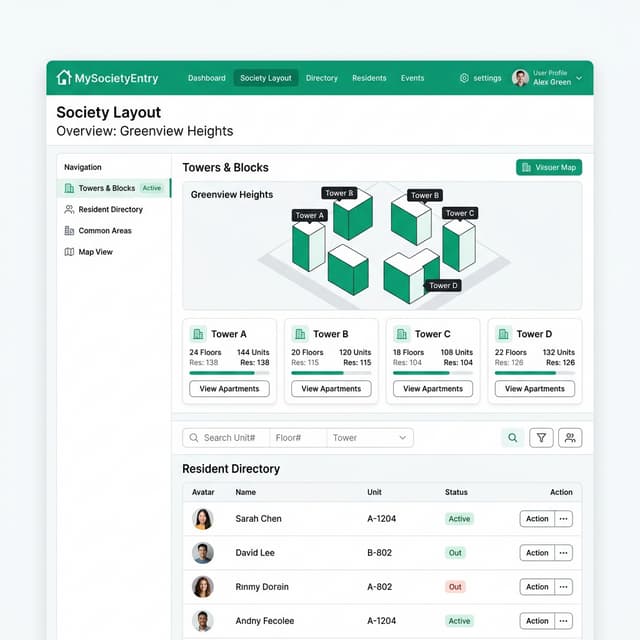
MySocietyEntry does not replace your society's statutory registers or decide which ones your state's cooperative law requires — that stays a bye-law and registrar's-office question your committee should confirm locally. Where the platform helps is in keeping the records that feed those registers current and in one place instead of scattered across notebooks and someone's personal files: the resident directory tracks flat-wise membership details as they change, complaints move through a dated workflow instead of a verbal log, dues and defaulter status stay current on the billing ledger rather than being recalculated by hand, and notices sent to residents are archived on the same digital notice board rather than existing only as a WhatsApp message someone may or may not have saved. That does not remove the secretary's responsibility to maintain the formal statutory registers, but it does mean fewer of the underlying facts have to be reconstructed from scratch when it is time to update them.
Final takeaway
Statutory registers cause committees trouble almost exclusively when they are treated as an annual audit chore instead of a living record. A nomination register, a minutes book, and a defaulter register are only useful if they reflect what actually happened when it happened — not a best effort assembled the week before the auditor arrives. Assign clear ownership, update registers as events occur, and hand them over formally at every committee transition, and the statutory record-keeping requirement stops being a recurring audit finding and becomes what it is meant to be: a reliable account of the society's own history.
See It In Action
Explore Society Management Software
MySocietyEntry helps committees turn guidance like this into a working process instead of another spreadsheet.
Society Management Software