
Pet Rules in Housing Societies: A Guide for RWA Committees
Whether a society can actually ban pets, what a managing committee can reasonably regulate instead, and the bye-law mistakes that get overturned when a pet owner pushes back.
Why pet rules keep landing on the committee's agenda
Almost every managing committee eventually has this discussion: one resident wants to keep a dog or cat, another resident on the same floor objects, and someone suggests the society simply "make a rule" banning pets or restricting them to certain flats, floors, or lift timings. It feels like a routine governance decision — the kind of thing a general body resolution should be able to settle. In practice, it is one of the more legally constrained decisions a committee can make, and outright bans or blanket restrictions passed by a majority vote are the ones most likely to be challenged and set aside when a resident pushes back.
This is worth getting right before a policy is drafted, not after a complaint is filed. A committee that understands what it can and cannot regulate ends up with a workable, defensible pet policy. A committee that treats the general body's majority vote as unlimited authority tends to end up defending a bye-law that does not hold up.
Can a society actually ban pets
Keeping a companion animal in your own flat is treated as a private, lawful activity, not something a society's bye-laws or a general body resolution can prohibit outright. The legal basis most commonly cited includes the Prevention of Cruelty to Animals Act, 1960 (which makes abandoning an animal an offence, which is relevant when a "no pets" rule effectively forces an existing owner to give one up) and guidelines issued by the Animal Welfare Board of India on the treatment of pet and community animals. Building on this, courts and consumer forums — including rulings from the Bombay High Court and state consumer disputes redressal forums — have repeatedly set aside society decisions that tried to ban pets outright, restrict them by breed or size, charge a special "pet fee," or bar them from common areas like lifts and gardens that every other resident is free to use.
None of this means a society has no say at all. What it means is that the society's authority is over conduct and hygiene, not over whether a resident is allowed to own a pet in the first place.
What a committee can reasonably regulate
- Requiring pets to be leashed or otherwise controlled in common areas like lobbies, gardens, and parking
- Reasonable expectations around cleaning up after a pet in shared spaces
- Basic vaccination and municipal pet registration records, where the local municipal corporation requires registration
- A process for residents to flag a specific pet's aggressive or dangerous behaviour, handled case by case rather than through a blanket rule against a breed or species
- Quiet-hours expectations for excessive barking or noise, consistent with how the society already handles other noise complaints
Where committee-drafted pet rules commonly go wrong
- A blanket "no pets" clause added to the bye-laws or passed as a general body resolution, treated as binding on existing and future residents alike
- Restrictions based on breed or size — for example, banning specific dog breeds — rather than addressing actual behaviour on a case-by-case basis
- Barring pets from using the main lift, or requiring pet owners to use a separate service lift, when no equivalent restriction applies to any other resident
- A separate "pet maintenance charge" or deposit added to the monthly bill, framed as a fee for extra wear on common areas
- Committee members or security staff informally pressuring a resident to give up a pet, rather than working through the resident directory and a documented complaint process when there is an actual, specific issue
- No distinction drawn between owned pets living in a flat and unrelated questions like community animal feeding on the premises, which are governed by their own separate set of municipal and AWBI guidelines and should not be folded into the same bye-law
What a workable, defensible pet policy actually looks like
- A written policy focused on conduct — leashing, common-area cleanliness, noise — rather than ownership or breed
- A documented process for raising a specific pet-related complaint, tied to a flat and a date, rather than handled as an informal committee-versus-resident dispute
- No separate pet fee unless the society's bye-laws and applicable state cooperative society rules genuinely permit charging for a defined, specific service
- Clear separation between rules for owned pets and rules around community or stray animals on the premises, since these raise different legal questions
- A general body discussion that results in guidance the committee can actually enforce, rather than a resolution that a resident is likely to successfully challenge
How MySocietyEntry helps
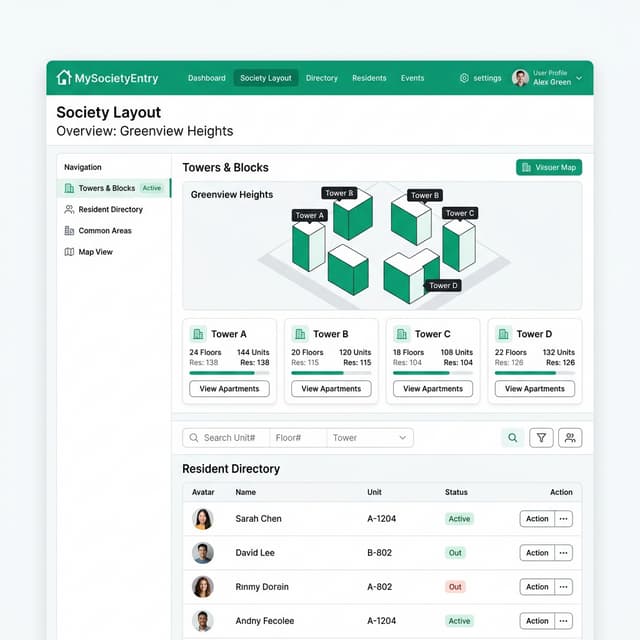
MySocietyEntry does not set your society's pet policy — that stays a bye-law and general body decision your committee should frame carefully, ideally with legal input given how often these disputes escalate. Where the platform helps is in keeping the process around it clean: a pet-related complaint from a resident goes through the same complaint management workflow as any other maintenance or conduct ticket, with a dated record instead of a verbal exchange that is hard to reconstruct later. Notices explaining the committee's actual policy — leashing expectations, common-area conduct, how to raise a concern — can go out through the same digital notice board residents already check, so the policy is documented and visible rather than passed around informally at the gate.
Final takeaway
A pet policy that focuses on conduct — leashing, cleanliness, noise, and a fair process for specific complaints — is one a committee can actually enforce and defend. A blanket ban, a breed restriction, or a special pet fee is the kind of rule that feels decisive in a general body meeting and then does not survive the first resident who takes it to a consumer forum. Committees that keep the two apart save themselves a dispute they are very unlikely to win.
See It In Action
Explore Society Management Software
MySocietyEntry helps committees turn guidance like this into a working process instead of another spreadsheet.
Society Management Software