
Society Maintenance Billing: A Practical Guide for RWAs
How Indian RWAs can move maintenance billing off spreadsheets and registers, choose the right billing model, and collect dues faster with fewer disputes.
Why maintenance billing is the hardest part of running a society
For most RWA committees, accounting is the single biggest source of friction. Late payments, manual receipts, spreadsheet errors, and mismatched ledgers eat up volunteer time every single month. Unlike visitor logs or notices, billing mistakes have a direct financial cost — and residents notice quickly when their dues or receipts do not add up.
Problems with spreadsheet and register-based billing
- Invoices are typed out manually every cycle, which invites errors and delays
- Payment tracking depends on someone updating a spreadsheet by hand
- Defaulters are hard to spot until someone manually cross-checks the register
- Receipts get delayed, lost, or issued inconsistently across flats
- Audit season becomes a scramble to reconstruct a full year of transactions
Common maintenance billing models societies use
- **Flat rate per unit** — every flat is billed the same fixed amount
- **Per square foot** — billing scales with the carpet or built-up area of each unit
- **Slab-based** — different rates apply based on unit size bands or usage tiers
- **Usage-linked charges** — parking, clubhouse, or backup power billed separately from core maintenance
Whichever model a society uses, the billing software should apply it consistently every cycle without someone recalculating it manually.
What a good digital billing workflow should include
- Auto-generated invoices on a fixed monthly or quarterly cycle, based on the society's billing rules
- UPI, card, and net banking collection with automatic reconciliation against each flat's ledger
- Instant digital receipts so residents are not waiting on the office for paperwork
- Automated late-fee and interest calculation applied the same way for every unit
- A clear defaulter view so the committee can follow up before dues pile up
- Exportable, audit-ready reports for AGMs and statutory review
How MySocietyEntry helps
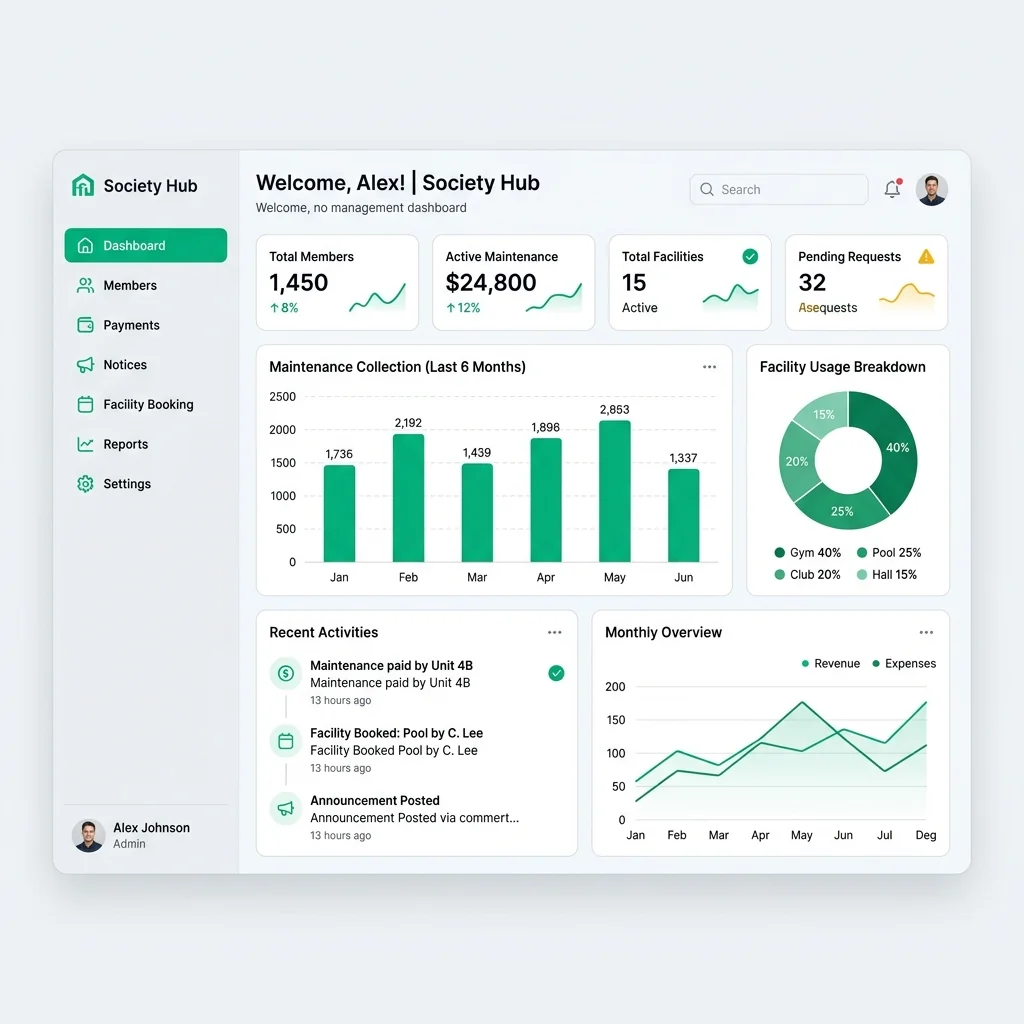
MySocietyEntry's accounting module handles flat-wise invoice generation, UPI and card payment collection, expense and vendor tracking, and defaulter reporting from one connected ledger. Instead of a committee member reconciling payments from a bank statement against a spreadsheet, collections update automatically and stay tied to each flat's history — the same data residents, treasurers, and auditors are looking at.
Getting your society off manual billing
- Start by mapping your current billing rules — flat rate, per sq ft, or slab-based — so the software can be configured to match, not the other way around
- Migrate historical dues and opening balances before your first digital billing cycle
- Give residents a heads-up before switching so they know where to check bills and make payments
- Run one cycle in parallel with your existing process before fully cutting over
Final takeaway
Maintenance billing does not have to depend on one volunteer's spreadsheet skills. A society accounting system that automates invoicing, payment collection, and defaulter tracking turns the most error-prone part of RWA operations into something the committee can trust — and hand over cleanly when volunteers change.
See It In Action
Explore Society Accounting Software
MySocietyEntry helps committees turn guidance like this into a working process instead of another spreadsheet.
Society Accounting Software