
Non-Occupancy Charges in Housing Societies: A Practical Guide for RWA Treasurers
What non-occupancy charges are, why they exist, how the widely-cited 10% cap actually works, and the billing mistakes that get societies challenged before the Registrar.
Why non-occupancy charges keep coming up at committee meetings
Almost every housing society with a mix of owner-occupied and rented flats eventually has this conversation: a flat gets rented out, and someone on the committee asks whether the owner should now pay something extra on top of regular maintenance. That extra amount is a non-occupancy charge, and it is one of the more frequently misapplied line items on a maintenance bill — either skipped entirely by societies that do not realise they can levy it, or set too high by societies that treat it as a discretionary penalty rather than a capped, rule-based charge.
Getting this right matters more than it looks. Non-occupancy charges that exceed what state cooperative society law allows are a common ground for members to challenge a society's billing before the Registrar or in consumer forums, and disputes here tend to drag on because they mix a genuine legal question with strained relations between the committee and a renting owner.
What a non-occupancy charge actually is
A non-occupancy charge (NOC) is a fee a cooperative housing society can levy on a flat owner when the flat is occupied by someone other than the owner or their immediate family — most commonly because it has been given out on rent or leave-and-license. The logic behind it is that a rented-out unit places some additional load on common services and administration, and the charge is meant to cover that, not to function as a penalty for renting.
It is important to separate this from two things it is often confused with:
- **Regular maintenance charges** — every flat pays these regardless of occupancy; non-occupancy charges are an addition on top, only when the flat is rented out
- **Transfer premium** — a one-time charge societies can levy when a flat's ownership changes hands (a sale), which is a completely separate charge governed by its own rules and is not the same as a recurring non-occupancy charge on a rented flat
The widely-cited 10% cap, and why it is not automatically nationwide
The rule most often quoted for non-occupancy charges is a 10% cap — the charge cannot exceed 10% of the service charges component of the monthly maintenance bill, excluding items like municipal property tax and water charges. This specific cap comes from Maharashtra's cooperative society framework (a government order under Section 79A of the Maharashtra Co-operative Societies Act) and has been the subject of Supreme Court rulings that upheld it.
Because Maharashtra has some of the largest concentration of registered cooperative housing societies in India, this 10% figure gets repeated widely as if it were a universal rule — but non-occupancy charges are governed by state-level cooperative society law, and the details differ by state. Some states apply a similar cap under their own cooperative rules, others have little specific regulation on the point, and a few have restricted or discouraged the charge altogether. A committee should confirm the actual position under its own state's Cooperative Societies Act and any circulars from its Registrar's office rather than assume the Maharashtra figure applies as-is.
How the charge should be calculated (where a cap applies)
Where a 10% (or state-equivalent) cap applies, the calculation basis matters as much as the percentage:
- The charge is calculated on the **service charges** portion of the maintenance bill only — not on the total bill, and not on components like sinking fund, repair fund, property tax, or water charges
- Example: if the service charges line in a flat's monthly bill is ₹4,000, a 10% non-occupancy charge would be ₹400 per month — not 10% of the full maintenance bill, which is a common overcharging mistake
- The charge is billed **per month the flat remains rented out**, not as a one-time fee, and should stop the moment the flat reverts to owner-occupancy or the tenancy ends
Where societies commonly get this wrong
- Calculating the percentage on the full maintenance bill instead of the service charges component alone, which inflates the charge well beyond what is allowed
- Levying a flat lump-sum "rental fee" decided informally at a committee meeting instead of a documented, rule-based percentage
- Continuing to bill the charge after a tenant has vacated and the owner has moved back in, because the flat's occupancy status was never updated in the billing records
- Applying non-occupancy charges to a flat occupied by the owner's parents, children, or other defined immediate family — most state rules exempt this kind of occupancy from the charge
- No written policy or resolution on file explaining the rate and basis, leaving the committee unable to show it followed a consistent rule when a renting owner disputes the bill
What a defensible non-occupancy billing process looks like
- A written committee resolution setting the exact rate and calculation basis, referencing the applicable state cooperative rule or circular
- A simple process for owners to declare when a flat is rented out (and when a tenancy ends), so the charge starts and stops on the correct billing cycle rather than being backdated or missed
- Non-occupancy charges shown as a clearly labeled separate line on the bill, not folded into a generic "other charges" figure the owner cannot verify
- A record of which flats are currently classified as non-occupied, kept in sync with actual tenancy status rather than relying on someone remembering to update it
How MySocietyEntry helps
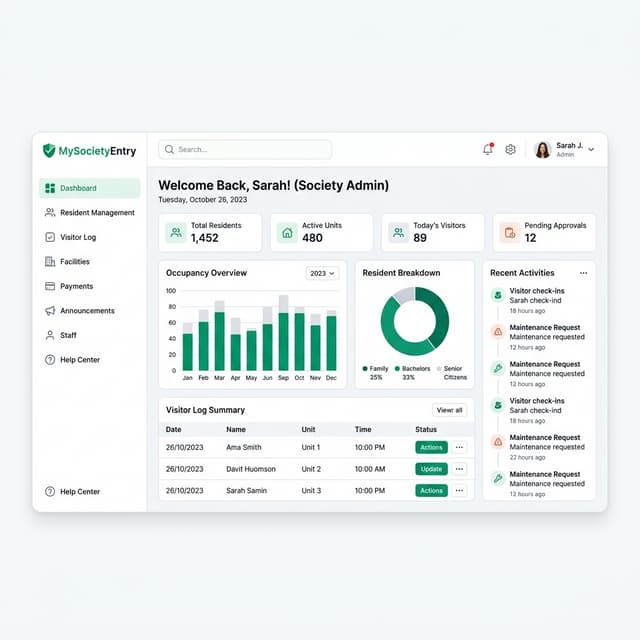
MySocietyEntry does not decide what rate your society should charge — that stays a state-law and committee-resolution question your treasurer and managing committee should confirm locally. Where the platform helps is in applying whatever rate the committee sets consistently and transparently: non-occupancy charges can be configured as a distinct billing component tied to a flat's occupancy status, calculated automatically on the correct base rather than worked out by hand every cycle, and shown to the resident as its own line item on the maintenance invoice. When a flat's occupancy status changes, updating it in the resident record adjusts future bills going forward, so the charge does not linger after a tenant has moved out or get missed when a new tenancy starts.
Final takeaway
Non-occupancy charges are legitimate and, in many states, capped by clear rules — but the disputes societies run into almost always come from applying the charge inconsistently rather than from the charge existing at all. Confirm the actual rule your state's cooperative law sets, calculate it on the correct base, document it in a resolution, and keep occupancy status current on every bill. That is what turns a recurring source of committee friction into a routine, defensible billing line.