
Online Maintenance Payment Collection for Housing Societies: A Practical Guide
Why cash and bank-transfer collection slows committees down, what a proper online payment setup needs, and how UPI, cards, and automated reminders change monthly reconciliation.
Why online payment collection matters for maintenance dues
Every society eventually generates maintenance bills correctly, but a surprising number still collect the money the hard way — cash handed to a committee member, cheques dropped at the office, or bank transfers that arrive with no reference to the flat or the bill they were meant to settle. The billing can be perfectly accurate and the collection process can still be the slowest, most error-prone part of the month.
Where manual collection breaks down
- Bank transfers with no flat number or bill reference, leaving the treasurer to guess who paid what
- Cash payments that depend on someone being physically available to receive and record them
- Cheques that bounce or take days to clear, delaying confirmation of who has actually paid
- No automatic link between a payment and the specific bill it settles, so reconciliation is done manually against a spreadsheet
- Residents who pay correctly but still get late reminders because the payment was not recorded in time
What a good online payment setup should include
- Multiple payment modes in one flow — UPI, debit/credit cards, and net banking — so residents can pay however is easiest for them
- Payments linked automatically to the specific maintenance bill, not just credited to a general society account
- An instant digital receipt for every payment, without anyone having to generate one manually
- A resident-facing payment history so residents can see their own record without asking the office
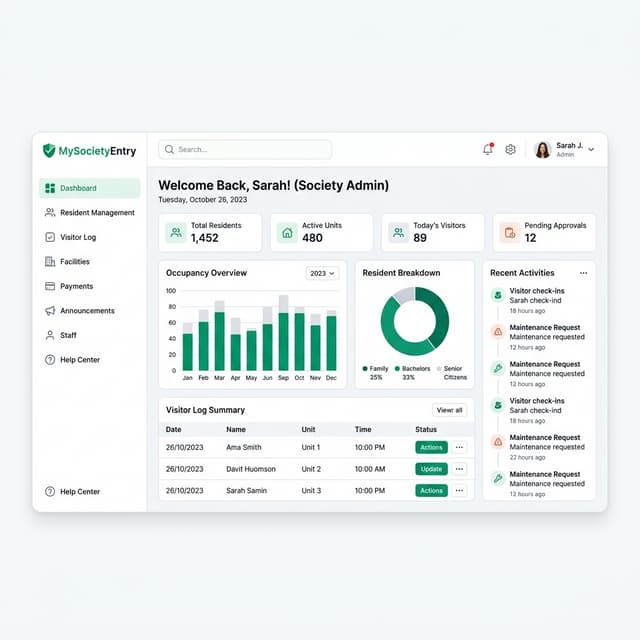
- A dashboard for the committee that reflects payment status in real time, not after manual entry
Handling partial payments and reminders
Even with online collection, some residents will pay late or in installments. The setup should distinguish clearly between fully paid, partially paid, and unpaid bills, and reminders should go out automatically as a due date approaches rather than depending on someone remembering to send them. A resident who has already paid should never receive a reminder meant for someone who hasn't — that kind of mistake is one of the fastest ways to damage trust between a committee and its residents.
Reconciliation and reporting
The real benefit of online collection shows up at month-end. Instead of matching a bank statement against a paper register line by line, the treasurer should be able to pull a report showing exactly what was billed, what was collected, what remains outstanding, and by which mode each payment came in. That report should be exportable, since committees regularly need it for AGMs, audits, or a new treasurer's handover.
How MySocietyEntry helps
MySocietyEntry's accounting module supports UPI, debit and credit cards, and net banking for maintenance payments, with each payment linked to its bill and reflected in the admin dashboard immediately. Residents get an instant digital receipt and a payment history they can check themselves, and the committee gets a reconciled view of collections without matching bank entries by hand.
Final takeaway
The biggest gap in most societies' finances isn't billing accuracy — it's the manual work between a bill being sent and a payment being confirmed. Moving that step online, with payments linked directly to bills and reconciled automatically, saves the treasurer hours every month and gives residents a faster, clearer way to pay.
See It In Action
Explore Society Accounting Software
MySocietyEntry helps committees turn guidance like this into a working process instead of another spreadsheet.
Society Accounting Software