
NOC for Flat Resale in Housing Societies: A Practical Guide
Whether a society NOC is actually required for a flat sale, what documents and dues checks it involves, and how committees can issue it without holding up a resident’s transaction.
Why the society NOC comes up in almost every resale
A flat resale rarely closes without someone asking for a "society NOC" at some point in the process — a buyer's bank wants one before releasing a loan, a sub-registrar's office may expect one at registration, or the outgoing member simply wants a clean handover. What that certificate actually needs to say, and whether the society can legally withhold it, is where most of the confusion sits. Committees that treat it as a routine administrative step handle it quickly. Committees that treat it as leverage over an unrelated dispute end up in exactly the kind of complaint that reaches a cooperative court.
What a society NOC for resale actually is
At its core, the NOC is the society confirming it has no objection to the transfer of a flat and, usually, that the outgoing member has no outstanding dues against that unit. It is not a title document and it does not establish ownership — that comes from the registered sale deed and the share certificate transfer. Buyers and lenders ask for it anyway because it is a quick, society-verified signal that the flat's dues are clear and the transfer is known to the managing committee.
Is it legally mandatory
This varies by state, and by the type of registered entity the community actually is. In Maharashtra, for example, the model bye-laws framed under the Cooperative Societies Act do not make a society NOC mandatory for a member to transfer their flat — a share transfer can generally proceed once the correct transfer forms, fees, and dues clearance are in order. In practice, though, many societies still ask for one, and banks and sub-registrar offices in several cities continue to expect it as a supporting document even where it is not strictly required by law. Because the requirement depends on your state's cooperative societies act, your society's own registered bye-laws, and evolving local practice, committees and sellers should confirm the current position with the Registrar's office or a society consultant rather than assume the rule in one city or state applies elsewhere.
What committees typically ask for before issuing one
- A copy of the registered sale or transfer agreement
- The outgoing member's share certificate for endorsement or reissue
- Identity and address proof for both the outgoing and incoming member
- A filled transfer form as prescribed by the society's bye-laws
- Confirmation that maintenance dues, sinking fund contributions, and any other society charges are fully cleared
- Payment of the transfer fee or premium, where the society's bye-laws permit one
Where committees get the transfer fee wrong
Several states cap what a society can charge as a transfer premium, and Maharashtra is a clear example: the model bye-laws set a maximum transfer premium of ₹25,000, regardless of the flat's sale value, and specifically prohibit collecting any additional amount as a "donation" or under any other label. A committee that asks for a larger contribution to the sinking fund or a separate "welfare fund" payment as a condition for issuing the NOC is usually acting outside its own bye-laws, even if the request is framed informally rather than as an official demand.
Where NOC requests get stuck in practice
- The committee delays issuing the NOC to pressure the outgoing member over an unrelated dispute, like a parking disagreement or a past complaint
- Dues calculations are pulled together manually at the time of the request, instead of coming from a ledger that was already current
- The transfer fee charged exceeds what the society's bye-laws or state rules actually permit
- No dated record exists of when the request was made and when the NOC was issued, which becomes a problem if the timeline is ever questioned
- The incoming member's details are not properly updated in the society's own records after the transfer, so future notices and bills still go to the previous owner
What a clean resale handover needs on record
- A dated log of the NOC request and the date it was issued, so the society can show it acted within a reasonable time
- A dues clearance check pulled directly from the current billing ledger, not recalculated by hand for the occasion
- A transfer fee applied consistently with the society's bye-laws, with no additional charges added informally
- Updated membership and contact records for the incoming resident as soon as the transfer is confirmed
- A retained copy of the NOC, transfer form, and supporting documents in the society's own records, not just with the outgoing member
How MySocietyEntry helps
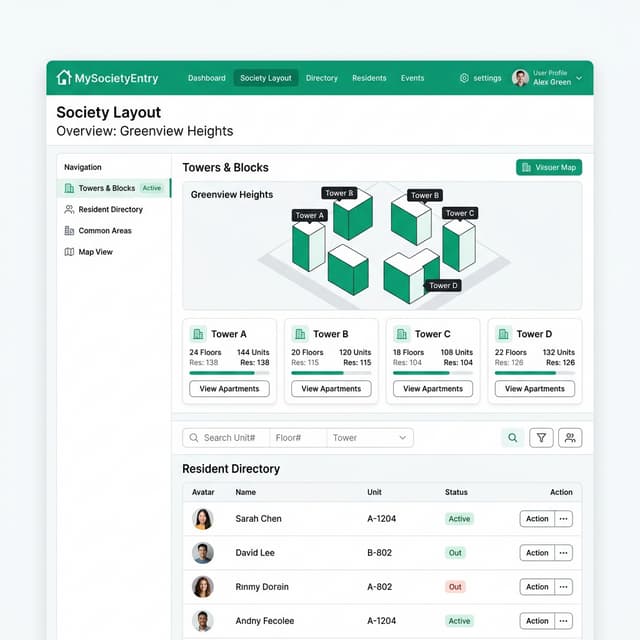
Because maintenance billing and dues sit on one continuously updated ledger, checking whether an outgoing member has any outstanding balance is a matter of looking at their current flat record rather than reconstructing months of payments by hand. Once a transfer is confirmed, updating the resident directory keeps notices, bills, and future communication going to the right person from day one, instead of continuing to reach whoever sold the flat.
Final takeaway
A society NOC for resale should be a quick confirmation of two things: dues are clear, and the committee knows about the transfer. It causes problems only when committees turn it into leverage for an unrelated grievance, or when dues and fees are calculated inconsistently because there is no current, reliable record to check against. Keeping billing current and transfer requests logged is what turns this from a recurring flashpoint into what it is supposed to be — a formality.
See It In Action
Explore Society Management Software
MySocietyEntry helps committees turn guidance like this into a working process instead of another spreadsheet.
Society Management Software