
Rooftop Solar for Housing Societies: The RWA Approval Process and PM Surya Ghar Yojana
Common-area electricity for lifts, pumps, and lobby lighting is one of the few maintenance costs a society can actually reduce with a one-time investment. What the approval process looks like, and what the central subsidy for group housing societies actually covers.
Why rooftop solar keeps coming up at committee meetings
Common-area electricity — lift motors, water pumps, lobby and staircase lighting, and CCTV or gate equipment running around the clock — is one of the few maintenance line items that grows every year without a society adding anything new. Unlike a sinking fund contribution or a staff salary, it is not something a committee can renegotiate; it is billed at whatever rate the DISCOM charges that month. That is the reason rooftop solar for common-area load has moved from an occasional resident suggestion to something committees actually put on the AGM agenda: it is one of the few maintenance costs a society can reduce with a one-time capital decision instead of an annual budget fight.
The catch is that a rooftop solar project on a shared building is not the same decision an individual homeowner makes for a standalone house. The terrace is common property, the connection is typically shared or split across multiple meters, and the approval chain runs through the general body before it ever reaches a DISCOM.
What the central subsidy actually covers for a society
The government's PM Surya Ghar Yojana rooftop solar scheme includes a specific track for Group Housing Societies (GHS) and Resident Welfare Associations, separate from the individual-household track most people hear about. For societies, the subsidy is aimed at common-area electricity consumption — the lifts, pumps, lobby lighting, and shared equipment a society bills through its own maintenance budget — rather than at individual flats. As of the scheme's current published terms, it supports systems up to 500 kW capacity for common-area use, with a subsidy rate quoted per kW of installed capacity for the GHS/RWA category. Subsidy rates, capacity limits, and the application process are the kind of detail that gets revised between scheme updates, so a committee evaluating this should confirm the current figures on the scheme's official portal or with an empanelled vendor rather than working from a number that may be out of date by the time a proposal reaches the AGM.
What matters for planning purposes is the structure: the RWA or GHS applies as a single unit for the common-area system, not each flat owner separately, and the subsidy is designed to bring down the society's own electricity spend rather than any individual resident's bill.
Common-area load vs individual flat connections
- A common-area rooftop system is sized against the lifts, pumps, lighting, and shared equipment billed on the society's own electricity connection — this is the project most societies are actually evaluating
- A system covering individual flats' consumption is a different arrangement, generally run through group net metering or virtual net metering, where one shared installation's generation credits are apportioned across multiple individual meters in an agreed ratio under the local DISCOM's framework
- The two are not mutually exclusive, but they are separate approvals with separate paperwork, and a committee should be clear with residents about which one is actually being proposed before a vote is taken
- Terrace space is usually enough for common-area sizing on a mid-size building, but a committee evaluating an individual-flat model should confirm early whether the available roof area can technically support it before residents are asked to commit financially
The approval process inside the society
- Put the proposal to the general body with a clear scope: system capacity, estimated cost, expected subsidy, payback period, and which load it will offset — a vague "let's go solar" motion invites exactly the kind of confusion that stalls a project later
- Get the resolution passed and minuted before any vendor discussion goes further than a preliminary quote, since the DISCOM application and NOC process both expect documented society approval, not just committee-level informal agreement
- Confirm terrace access and any structural or waterproofing implications with the society's own maintenance records before committing terrace space that may already be earmarked for a water tank expansion, a telecom tower lease, or a future lift overhaul
- Decide, and record, who signs and maintains the vendor contract on the society's behalf and how warranty or service issues will be raised after installation — this becomes an open question surprisingly often once the person who championed the project rotates off the committee
What the DISCOM process generally involves
- A feasibility application to the local DISCOM, which reviews the technical proposal against the existing connection and sanctioned load
- Documentation typically including a no-objection certificate from the society, a single-line diagram showing how the panels, inverter, and meter connect, and equipment specifications with IEC-certified test certificates
- For a multi-connection or society-level system, this review generally takes longer than an individual household application — plan for a multi-week feasibility and approval window rather than assuming installation can start immediately after a vendor is chosen
- Net metering installation and commissioning by the DISCOM after the physical system is installed, which is what actually enables the society to draw subsidy-linked credit for the power it generates
- Requirements, forms, and timelines vary by state DISCOM, so a committee should treat a vendor's stated timeline as an estimate and confirm the current process with the relevant DISCOM directly
Where societies typically run into trouble
- Choosing a vendor based on the lowest quote without checking whether that quote actually reflects the subsidy the society is eligible for, leaving the society to discover the gap after committing
- No clarity on who owns the system, the account, and the warranty once installed — vendor-financed or third-party-owned models exist and can suit some societies, but this needs to be understood and approved explicitly, not assumed
- Treating the general body resolution as a formality rather than getting real sign-off on cost-sharing, since a capital cost funded partly from the corpus or sinking fund is exactly the kind of spending that should have a clear, minuted mandate
- No maintenance plan after installation — panel cleaning, inverter servicing, and periodic performance checks are the difference between a system that keeps generating at close to its rated output and one that quietly underperforms for years without anyone noticing
- Underestimating the DISCOM approval timeline and locking in a vendor payment schedule that assumes a faster net-metering turnaround than typically happens
Questions to ask before signing a solar vendor
- Is the vendor empanelled with the relevant state DISCOM or the national rooftop solar portal, and can they confirm the current subsidy figure the society qualifies for at time of signing?
- Does the quote clearly separate system cost, subsidy amount, and the society's net payable, rather than presenting a bundled number that is hard to verify later?
- Who handles the DISCOM feasibility and net-metering paperwork — the vendor or the society — and what happens to the project timeline if that approval takes longer than expected?
- What does the annual maintenance plan include, and is it priced separately or bundled into the installation cost?
- What is the expected payback period against the society's actual common-area electricity bill, not a generic industry figure the vendor quotes for every prospective customer?
How MySocietyEntry helps
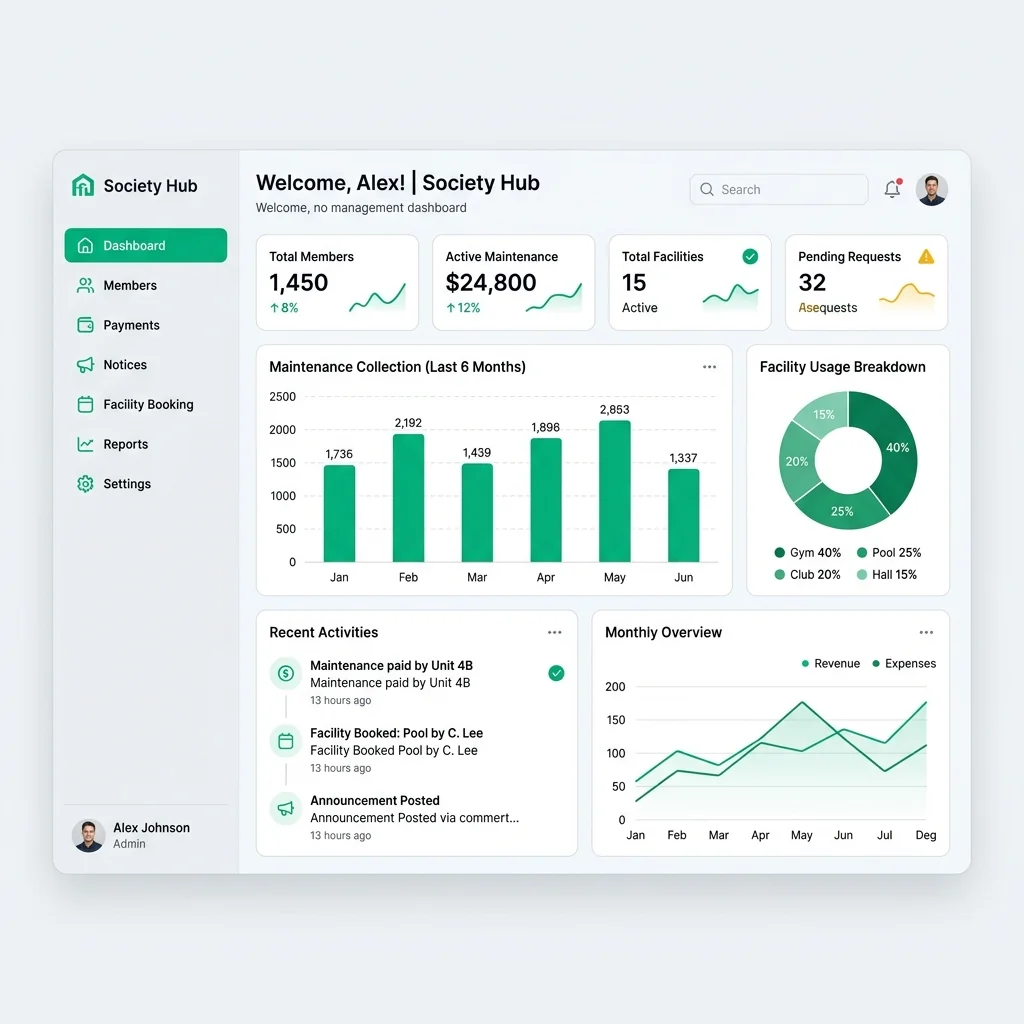
MySocietyEntry does not install or maintain solar systems — that stays with the society's chosen EPC vendor and the local DISCOM. Where the platform helps is around the decision and the paperwork that follows it: the general body resolution and any cost-sharing decision can sit in the same records the committee already uses for other capital approvals, the solar vendor's contract and annual maintenance visits can be tracked through the same vendor and expense management workflow as every other society contractor, and once the system is generating savings, the reduced common-area electricity spend shows up directly in the society's own expense reports — giving the committee an actual before-and-after number to show residents, instead of a one-time announcement nobody can verify a year later.
Final takeaway
Rooftop solar for common-area load is one of the few capital decisions a housing society can make that pays back in a line item residents already see every month. The subsidy structure for group housing societies makes the economics genuinely favourable for many buildings, but the project still runs through the same discipline as any other major society expense: a clear general body mandate, a vendor selected on verified terms rather than the lowest quote, a realistic DISCOM approval timeline, and a maintenance plan that keeps the system performing years after the installation photos are taken.
See It In Action
Explore Society Accounting Software
MySocietyEntry helps committees turn guidance like this into a working process instead of another spreadsheet.
Society Accounting Software