
Water Tank Cleaning Compliance for Housing Societies: A Practical Guide for RWA Committees
A tank that looks clean is not the same as a tank that is safe. What municipal health guidelines generally expect for cleaning frequency and water testing, why confined-space safety is the most overlooked part of the job, and the record a committee should keep if a resident ever complains about water quality.
Why "the tank looks fine" is not the same as "the tank is safe"
Every housing society depends on an underground sump and one or more overhead tanks to store the water residents drink, cook with, and bathe in, yet tank cleaning is usually the maintenance line item that gets the least attention until something goes visibly wrong — discoloured water, a smell, or a resident complaint after a monsoon. By the time that happens, the more relevant question for a committee is not "when did we last clean the tank" but "can we show what we did and when."
This is general guidance on how water tank cleaning is typically expected to be handled for Indian housing societies, not a substitute for checking your own city's municipal or public health engineering department rules. Exact cleaning-frequency mandates, contractor licensing requirements, and reporting obligations differ between municipal corporations and states, and enforcement intensity varies considerably between cities. A committee should confirm its own obligations with its municipal health department or water board rather than assume a generic answer applies everywhere.
Where the obligation typically comes from
- Municipal health and sanitation bye-laws generally require residential buildings to keep water storage tanks — both the underground sump and any overhead tank — clean and free of contamination, as part of the same public health framework that governs sewage and solid waste
- A society's own registered bylaws typically place general responsibility for maintaining common-area utilities, including water storage infrastructure, on the managing committee, independent of any specific municipal notification
- Municipal corporations and water boards in several cities issue periodic advisories, particularly before or after the monsoon, reminding residential buildings to clean and disinfect storage tanks given the higher contamination risk during that season
- Health departments and RWAs' own building bye-laws commonly expect tanks to be covered, accessible for inspection, and free of cracks or open joints that let in surface water or debris — a design and maintenance expectation that sits alongside the cleaning schedule itself
What ongoing practice generally looks like
- Cleaning and disinfecting every water storage tank — both the underground sump and each overhead tank — on a fixed calendar cadence, commonly at least twice a year, and more frequently where the tank has a history of contamination, sits in a warmer or more exposed location, or serves a larger population
- Additional out-of-cycle cleaning after any plumbing repair near the tank, visible flooding or debris ingress, a period the tank was left uncovered, or a resident-reported water quality complaint
- A water sample tested after cleaning against drinking water quality parameters (India's official reference is IS 10500, the Bureau of Indian Standards specification for drinking water), with the dated report retained rather than a vendor's verbal assurance that the water is "fine now"
- Recognising that tank cleaning is confined-space work — workers descend into an enclosed space with limited ventilation and often standing water — so the vendor's manpower should follow basic confined-space safety practice (ventilation before entry, safety harness, a second person standing by) rather than being treated as routine housekeeping
Where societies commonly fall short
- Cleaning happens reactively, triggered by a complaint about smell, colour, or taste, rather than sitting on a fixed calendar the committee actually tracks
- The underground sump is neglected while the overhead tank gets attention, even though the sump is often at greater contamination risk from surface runoff, cracks, or nearby drainage
- No water sample is tested after cleaning, so nobody can actually confirm the cleaning improved water quality — the committee is relying on the tank simply looking cleaner
- No record is kept beyond a vendor's WhatsApp message confirming the job is "done" — no invoice, no photos, no test report — leaving the committee with nothing to show if a resident disputes water quality later
- A vendor is selected purely on the lowest quote without asking about manpower safety practice for what is legally confined-space work, or about how sludge and sediment removed from the tank are disposed of
Records a committee should be able to produce on request
- A cleaning calendar for the year covering every tank on the property — sump and all overhead tanks — with actual completion dates logged against it, not just planned dates
- The vendor invoice or contract for each cleaning cycle, including the manpower and method used
- A dated water quality test report for each cleaning cycle, or at minimum an annual test, covering standard potability parameters
- A log of any resident complaints about water colour, smell, or taste, and how each one was resolved
- Photographic or vendor-issued confirmation that cleaning was actually carried out, particularly for tanks that are not easily visible to residents
How MySocietyEntry helps
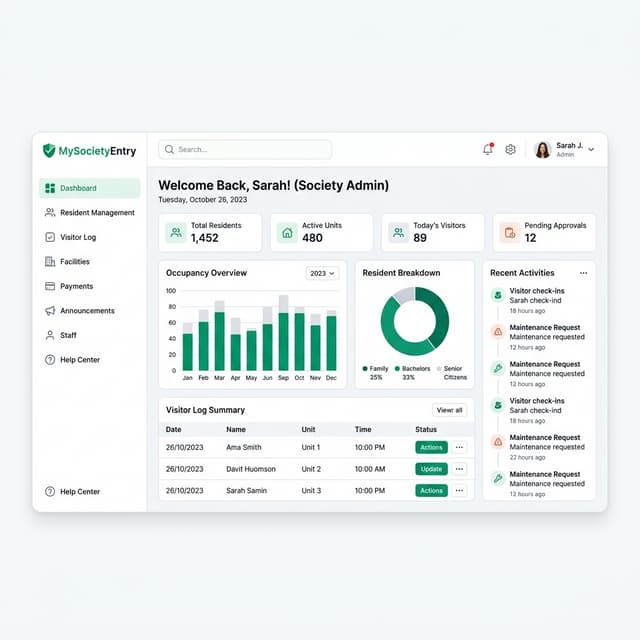
MySocietyEntry does not clean or test water tanks — that stays with the society's appointed vendor and, for water quality, an accredited testing lab. Where the platform helps is in keeping the surrounding record straight: the tank-cleaning vendor and its recurring contract sit in the same vendor and expense management workflow as every other society AMC, so the next due date is tracked centrally instead of depending on someone remembering to call the vendor; a resident's complaint about water colour or smell goes through the same complaint management flow as any other maintenance ticket, so a pattern across multiple flats is visible rather than looking like one-off feedback; and cleaning logs or test reports can be stored alongside the society's other maintenance and compliance records instead of scattered across a vendor's message thread that nobody else can search later.
Final takeaway
Water tank cleaning is easy to treat as a minor housekeeping task precisely because it is invisible when done well — nobody notices a tank that was cleaned on schedule and tested afterward. The gap that actually matters is between a society that cleans reactively with no record and one that runs both the sump and every overhead tank on a fixed calendar, tests the water afterward, and can produce that record the moment a resident asks whether the water is safe.
See It In Action
Explore Society Management Software
MySocietyEntry helps committees turn guidance like this into a working process instead of another spreadsheet.
Society Management Software