
Income Tax and TDS Rules for Housing Societies: A Practical Guide for RWA Treasurers
Why a "not-for-profit" RWA still files income tax returns, what the principle of mutuality actually covers, and the TDS obligations committees most often miss on contractor and professional payments.
Why a "not-for-profit" RWA still has income tax obligations
A common assumption in committee meetings is that a housing society, being a non-profit body that only collects maintenance from its own members, has nothing to do with income tax. That is only partly true. A registered society or RWA is a legal entity, and it is expected to file an income tax return every year like any other association of persons, even in years where it believes it owes no tax. Whether tax is actually payable depends on the type of income involved, not on the society's not-for-profit status alone.
This is general guidance on how income tax typically applies to RWAs and housing societies in India. Treatment can vary based on your society's specific income sources, registration type, and state, so use this as a starting point for a conversation with your society's chartered accountant, not as tax advice.
The principle of mutuality, in plain terms
Most of what makes RWA taxation different from a regular business comes down to the principle of mutuality. The idea is simple: an association cannot earn "income" from itself. When members contribute to a common maintenance fund and that fund is spent only on the society's own upkeep, there is no profit being made off an outside party — the contributors and the beneficiaries are the same people. Courts have generally accepted that this kind of surplus, arising purely from members' own contributions spent for their own common benefit, is not taxable income in the way a business's profit would be.
For mutuality to hold, three things generally need to be true: the contributors and the people who benefit from the fund must be the same group, the association's actions must stay within the purpose members formed it for, and there must be no possibility of the surplus being distributed as profit rather than returned to members through society expenses. A society whose activities move outside these lines — even in one area of its income — risks losing the protection of mutuality for that specific income, even if the rest of its collections remain covered.
What typically stays outside taxable income
- Regular maintenance charges collected from members and spent on the society's own upkeep
- Sinking fund and similar member contributions used strictly for the society's own long-term repairs and reserves
- Other member contributions raised and spent within the scope of the society's stated purpose
What is typically taxable even for a mutual association
- Interest earned on the society's bank deposits and fixed deposits, which is income from an outside party (the bank), not from members
- Rent or licence fees earned from letting out common areas — a terrace, hoarding space, mobile tower installation, or a shop — since that income comes from a non-member or a member acting outside the mutual relationship
- Charges collected from non-members, or from members for services unrelated to the mutual purpose of the association
- Any surplus arising from activity that falls outside the strict "same contributors, same beneficiaries, no profiteering" test
Committees are often surprised that FD interest is taxable even though the maintenance fund it came from was collected from members. The exemption follows the nature of the specific income, not the source ledger it sits in.
TDS obligations most committees miss
A society that pays contractors, security agencies, housekeeping vendors, or professionals above certain thresholds is generally required to deduct tax at source before making the payment, and to deposit and report it, regardless of whether the society itself owes any income tax that year. This obligation trips up committees most often on:
- Payments to security agencies, housekeeping contractors, and maintenance vendors under the contractor TDS provisions
- Fees paid to auditors, lawyers, architects, or other professionals under the professional-fee TDS provisions
- Rent paid by the society, in the less common cases where that applies
- Treating a vendor as a one-off "casual" payment when the aggregate paid to them over the year has actually crossed the deduction threshold
The exact rate and threshold for each category can change and vary by payment type, so a committee should confirm current figures with its CA before signing off on vendor payments rather than relying on last year's numbers.
Common mistakes societies make
- Not filing a return at all because the committee assumes a "no profit, no tax" society has no filing obligation
- Treating all society income as automatically covered by mutuality, including FD interest and rental income that generally is not
- Deducting TDS inconsistently — done for one vendor's contract but missed for another paid through informal cash payments
- Changing treasurers without handing over PAN details, past filing records, or TDS deduction history, so the new committee starts the year with gaps
- Reconciling vendor payments and interest income manually at year-end instead of tracking them through the year, leading to rushed and error-prone filings
What a defensible record should include
- A clear, dated ledger separating member maintenance income from bank interest, rental income, and any non-member charges
- Vendor payment records that show which payments crossed a TDS threshold and whether tax was deducted and deposited on time
- Copies of TDS certificates issued to vendors and challans filed with the department, kept with the society's other statutory records
- A documented handover of tax and TDS history whenever the treasurer or managing committee changes
How MySocietyEntry helps
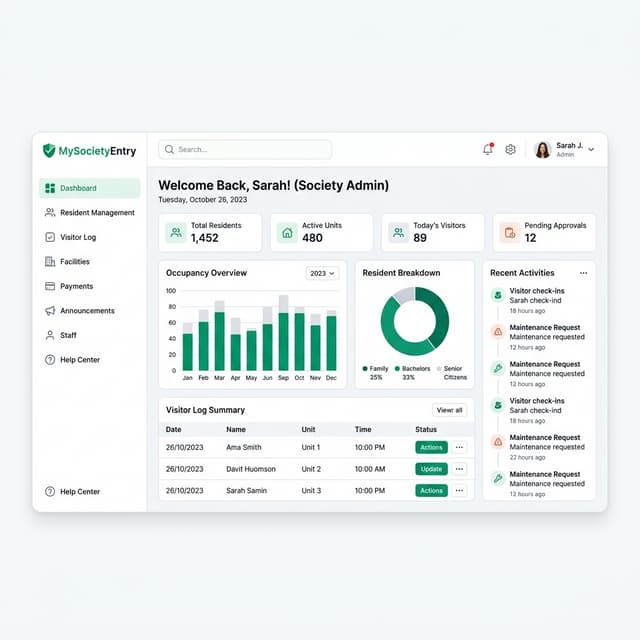
MySocietyEntry doesn't file returns or calculate tax liability — that stays with the society's CA — but the accounting module keeps the underlying numbers clean for them. Maintenance income, bank interest, rental income, and vendor payments sit on separate, dated ledgers rather than one mixed cash book, so a CA reviewing the year can see at a glance which income is member-collected and which came from an outside source. Vendor and expense records carry payment history over time, which makes it easier to check whether a contractor's aggregate payments have crossed a TDS threshold instead of reconstructing that from scattered invoices at filing time.
Practical steps for a committee reviewing this today
- Confirm with your CA whether your society's return has been filed for the last completed financial year
- Check whether bank interest and any rental or non-member income have been reported separately from exempt maintenance income
- Review vendor and contractor payments for the year to confirm TDS was deducted where it should have been
- Put a simple handover checklist in place so tax and TDS records transfer cleanly to the next treasurer
Final takeaway
The principle of mutuality protects a genuine housing society from being taxed on its own members' maintenance contributions, but it was never a blanket exemption from income tax altogether. Interest income, rental income, and TDS obligations on vendor payments sit outside that protection and need to be tracked and filed correctly every year. The committees that avoid trouble here are the ones that keep member income, other income, and vendor payments on separate, well-documented ledgers year-round, rather than trying to sort it all out once, under pressure, at filing time.