
Housing Society Compliance Calendar: Recurring Deadlines RWA Committees Shouldn’t Miss
Most housing society compliance failures are not caused by an unknown law — they happen because a deadline that recurs every single year was tracked in one person’s head instead of a shared calendar. What committees should be tracking, and when.
Compliance for a housing society is rarely one deadline — it is a recurring list
Ask most committees which statutory requirement they are least confident about, and the honest answer is usually not a single unfamiliar rule. It is the fact that the society's compliance obligations — the AGM, the audit, tax filings, and a handful of safety certificate renewals — recur every year on a rolling basis, and the only place tracking them lived was the outgoing treasurer's or secretary's memory. When that person moves out, rotates off the committee, or simply gets busy, deadlines slip quietly until a member, an auditor, or the registrar's office raises the alarm.
This guide covers the recurring compliance items most registered housing societies in India need to track through the year, organized as a calendar rather than a list of laws. The exact section, deadline, and authority that applies to each item is set by each state's co-operative societies act (or, for apartment associations, the relevant apartment ownership act) and by the society's own registered bye-laws, and these differ enough between states that a committee should confirm specifics with its registrar's office, its auditor, or a lawyer rather than treat this as a substitute for that advice. What stays constant everywhere is the underlying pattern: these obligations repeat every year, and the committees that struggle are almost always the ones tracking them informally.
Why compliance tracking breaks down in practice
- The full list of what needs renewing or filing lives in one office-bearer's memory or inbox, with no shared record the rest of the committee can see
- Deadlines are noticed only when they are already close — a lift license about to lapse, an AGM date creeping up — rather than planned for months in advance
- Committee handover at the end of a term does not include a documented list of what is due, what was last renewed, and what is coming up next
- Financial deadlines (audit, AGM, tax filing) and safety-certificate renewals (fire NOC, lift license) are tracked separately, if at all, so nobody has one view of the full year
- A renewal or filing that was done informally — a phone call, a payment without a retained receipt — leaves no paper trail to prove it happened when someone asks later
What a society's compliance calendar typically needs to cover
**Financial year-end cycle.** The annual statutory audit and the Annual General Meeting are usually planned together, since most state co-operative frameworks require audited accounts to be placed before the AGM, and both are generally expected within a set number of months of the financial year's close. Auditor appointment or reappointment is itself normally an AGM resolution, so it belongs on the calendar as a distinct action item, not an assumption that last year's auditor continues automatically.
**Tax filings.** Where a society's income (including non-member income, in many state frameworks) crosses the applicable threshold, an income tax return and any associated tax audit become annual filing obligations with their own due dates, separate from the co-operative audit. A society registered under GST for taxable supplies has its own recurring return-filing cycle to track as well.
**Safety and statutory certificate renewals.** Fire safety NOC renewal, lift/elevator AMC and statutory inspection certificates, PSARA license verification for any outsourced security agency, and STP or pollution-control compliance certificates (where applicable) each run on their own renewal cycle, usually annual, and typically involve a different authority or inspector than the financial deadlines above.
**Governance and registers.** Committee terms have a defined length under the bye-laws, after which fresh elections become due; statutory registers (membership, share certificates, meeting minutes, and similar records the act requires a society to maintain) need to stay current rather than be reconstructed when the registrar's office asks to see them.
What committees should avoid
Treating each of these as a one-off task to remember rather than a recurring line on a shared calendar is the single biggest failure pattern. Close behind it: letting only one person hold the full picture, so continuity breaks the moment that person is unavailable or steps down; renewing or filing something informally without keeping the receipt, acknowledgment, or certificate on record; and discovering a lapsed certificate or missed filing only when it becomes a problem — a lift inspection that has expired, an AGM held after the deadline with no valid explanation — rather than catching it while there is still time to act.
What a working compliance calendar looks like
- One shared, dated list covering financial deadlines and certificate renewals together, visible to the full committee rather than one office-bearer
- Each item tracked with its last completion date and its next due date, so the calendar shows what is coming up rather than just what happened
- Supporting documents — filed returns, renewed certificates, AGM resolutions — stored against each item so the record survives a committee handover
- A handover-ready summary that an outgoing committee can pass to an incoming one, instead of a mental list that leaves with whoever held it
How MySocietyEntry helps
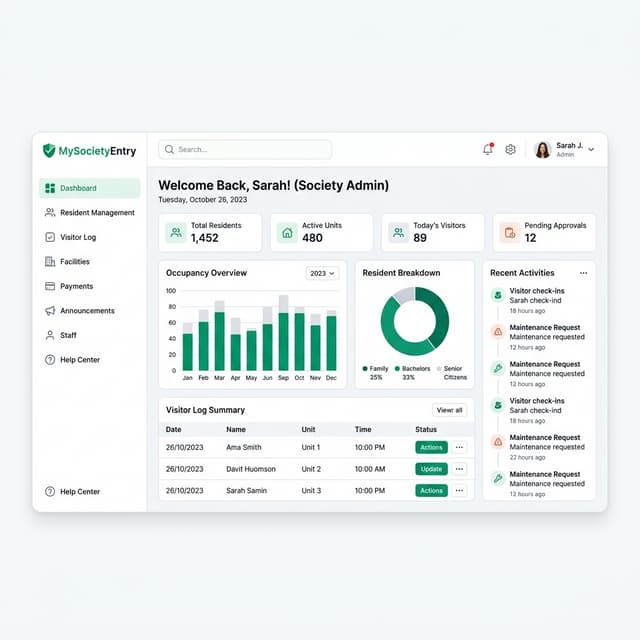
MySocietyEntry does not decide which state law applies to a society or file returns on a committee's behalf — those stay the responsibility of the committee, its auditor, and its registrar's office. Where the platform helps is in keeping the underlying records ready whenever a deadline comes up: accounting and dues data stay reconciled year-round so an audit or AGM presentation does not start from a blank spreadsheet, notices and resolutions are logged and searchable instead of scattered across WhatsApp and email, and records carry over cleanly when a committee changes, so the next treasurer or secretary is not starting the compliance calendar from memory.
Final takeaway
Very few housing society compliance failures come from a rule nobody knew existed. Most come from a recurring deadline that only one person was tracking, in a place nobody else could see. A committee that puts its AGM, audit, tax filing, and certificate-renewal dates on one shared calendar — with the supporting paperwork attached and the list handed over cleanly at every committee change — turns compliance from an annual scramble into a routine that survives who happens to be treasurer that year.
See It In Action
Explore Society Accounting Software
MySocietyEntry helps committees turn guidance like this into a working process instead of another spreadsheet.
Society Accounting Software