
Facility and Amenity Booking for Housing Societies: A Practical Guide
How Indian RWAs can move clubhouse, community hall, and sports facility bookings off registers and WhatsApp groups into a fair, trackable digital process.
Why facility booking causes more disputes than it should
Most societies have a handful of shared amenities worth fighting over: a clubhouse or community hall, a badminton or tennis court, a guest room, sometimes a swimming pool or party lawn. On paper, booking one should be simple. In practice, it is one of the more common sources of committee complaints, because the process usually depends on a physical register at the security desk, a phone call to the office, or a WhatsApp message that may or may not get a reply before the date in question.
Problems with manual facility booking
- A register or diary can be double-booked if two residents write down the same slot before anyone notices
- Residents have no way to check availability without calling or visiting the office
- There is no record of who confirmed a booking, so disputes over "I booked first" are hard to resolve
- Cancellations are not always updated in the register, so a released slot stays blocked
- Booking fees or refundable deposits are collected in cash or informally, with no clean paper trail
- Popular slots (weekends, festival dates) get informally reserved by whoever has a personal contact in the office
What a fair booking policy needs
Software alone does not fix a booking process that has no clear rules behind it. Before digitizing, a committee should settle a few basics: how far in advance residents can book, whether there is a cap on bookings per flat per month, what happens if a facility needs maintenance, and how refundable deposits are handled for cancellations.
- A published list of facilities, their capacity, and any usage restrictions
- Clear advance-booking windows so the same few flats cannot block every date months out
- A consistent fee and deposit structure applied the same way to every flat
- A defined process for maintenance blackout dates and committee-reserved events
What a good digital booking workflow should include
- A live calendar view showing which facilities are already booked, so residents see real availability before requesting a slot
- Slot- and capacity-based booking so a facility cannot be double-booked or overbooked
- An approval step for the admin or committee, with the request clearly marked pending until confirmed
- Online payment for booking fees or deposits, tied to the specific booking rather than collected separately in cash
- A simple cancellation flow that immediately frees up the slot for other residents
- A visible booking history so the committee can review usage patterns and resolve disputes with an actual record instead of memory
How MySocietyEntry helps
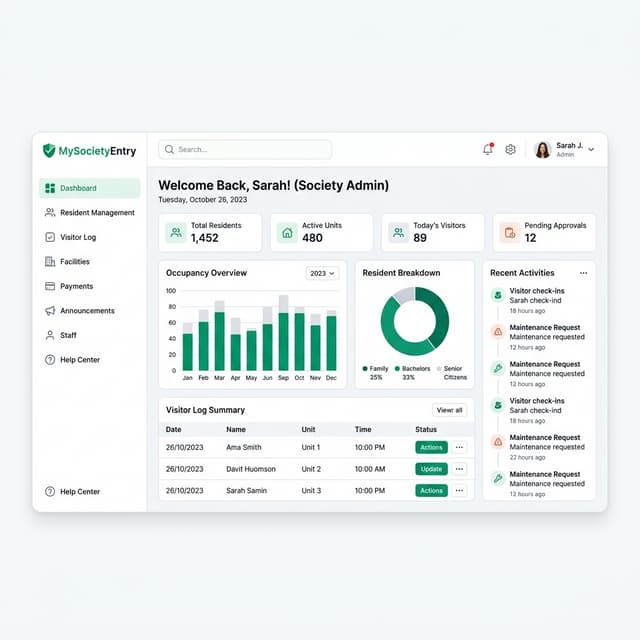
MySocietyEntry's facility booking module gives residents a calendar view of clubhouse, hall, and court availability by capacity, with bookings routed through a pending-approval step before they are confirmed. Residents can cancel a booking themselves when plans change, which releases the slot immediately instead of leaving it blocked, and booking-linked payments sit on the same ledger as the rest of the society's accounts instead of being tracked separately.
Rolling out digital facility booking without disruption
- Publish the facility list, capacity, and booking rules clearly before switching over, so residents are not guessing at what changed
- Start with the highest-demand facility first, since that is usually where disputes are most frequent
- Migrate any existing confirmed bookings into the new system before residents start booking on their own
- Give the security desk and office staff a short overlap period where they can still confirm a booking manually while residents get used to the app
Final takeaway
Facility booking disputes are rarely about the facility itself, they are about the absence of a shared, visible record of who booked what and when. A calendar-based system with clear approval, payment, and cancellation steps turns a recurring source of committee friction into a routine, self-service part of resident life.
See It In Action
Explore Society ERP System
MySocietyEntry helps committees turn guidance like this into a working process instead of another spreadsheet.
Society ERP System