
Complaint Management System for Housing Societies: A Practical Guide
Why WhatsApp groups and paper complaint registers break down as societies grow, and what a proper digital complaint workflow needs to actually resolve issues faster.
Why complaint handling breaks down as societies grow
Every society starts out managing complaints the same way: a resident calls the office, sends a WhatsApp message, or stops a committee member in the lobby. That works when a community is small. It stops working once a society has a few hundred flats, multiple vendors, and a rotating set of volunteer committee members — complaints get lost in group chats, nobody is clearly responsible for follow-up, and residents have no way to check status without asking again.
Problems with informal complaint handling
- Complaints raised over calls or WhatsApp have no record once the conversation scrolls past
- There is no single owner, so issues get forwarded between committee members and vendors without resolution
- Residents cannot see whether a complaint is open, in progress, or closed
- Recurring issues (a leaking pipe, a faulty gate motor) are hard to spot because there is no history to review
- Handovers between outgoing and incoming committee members lose context on unresolved issues
What residents and committees actually need
Residents mainly want two things: a simple way to raise an issue, and visibility into what is happening with it. Committees need the opposite side of the same problem — a clear queue of open issues, an easy way to assign them, and a record they can refer back to during AGMs or vendor reviews. A complaint system succeeds when it serves both sides from the same data, instead of residents chasing updates and committees maintaining a separate tracking sheet.
What a good digital complaint workflow should include
- A simple submission flow where residents can raise a complaint by category (plumbing, electrical, security, housekeeping, common area, and so on)
- Clear status tracking — open, in progress, resolved — visible to the resident who raised it
- A threaded conversation on each complaint so residents and the admin team can exchange updates without losing context
- Assignment to a specific staff member, vendor, or committee owner so accountability is clear
- A searchable history so recurring issues are visible instead of being treated as new each time
- Reporting that shows resolution time and complaint volume by category, so committees know where the real problems are
How MySocietyEntry helps
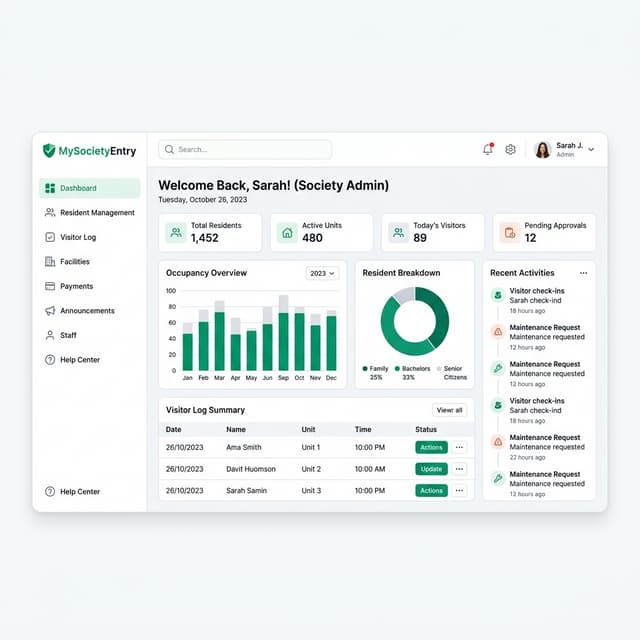
MySocietyEntry's complaint management module gives residents a simple way to raise and track complaints, with each ticket carrying its own status and a chat thread for updates between the resident and the admin team. Because complaints sit on the same platform as resident profiles and society records, the admin and committee always have the full picture — who raised what, when, and what has already been tried — instead of piecing it together from old messages.
Rolling out a complaint system without disruption
- Set clear complaint categories that match how your society actually operates, rather than a generic list
- Assign an owner for triage so new complaints do not sit unseen
- Migrate any genuinely unresolved issues from your current register so nothing falls through the transition
- Give residents a short heads-up on where to raise complaints going forward, so old habits like WhatsApp messages fade out gradually rather than abruptly
Final takeaway
Complaint handling is one of the clearest signals residents use to judge how well a society is managed. A system that gives residents visibility and gives committees a real queue — instead of a scattered mix of calls, messages, and memory — turns complaint resolution from a source of friction into something the community can actually trust.
See It In Action
Explore Society ERP System
MySocietyEntry helps committees turn guidance like this into a working process instead of another spreadsheet.
Society ERP System