
Apartment Parking Management: A Practical Guide for RWAs
How Indian housing societies can organize resident vehicle records, allocate parking slots fairly, and control visitor parking without paper registers.
Why parking is one of the most disputed topics in any society
Almost every RWA committee has dealt with a parking complaint — a visitor blocking a resident's slot, an unregistered vehicle parked overnight, or two flats claiming the same bay. Unlike billing or notices, parking disputes tend to escalate quickly because they play out in person, at the gate or in the basement, often without any record to settle who is right.
Common parking problems in Indian societies
- No central record of which vehicle belongs to which flat
- Slot handovers during resident move-outs are tracked informally or not at all
- Visitor vehicles occupy resident slots during events or peak hours
- Guards have no quick way to verify if a parked vehicle is authorized
- Basement and multi-zone layouts make it hard to track occupancy manually
What a fair parking policy needs
Before software can help, a society needs clear rules: how many slots each flat is entitled to, how visitor parking is handled, what happens during a resale or tenancy change, and how violations are flagged. Committees that skip this step often find that even a good digital system just digitizes the same confusion.
- A documented one-slot-per-flat (or equivalent) policy that residents have agreed to
- A separate process for visitor and short-stay parking
- A clear owner for approving exceptions, like a second vehicle or a guest staying longer
- A defined escalation path for repeat violations
What a digital parking workflow should include
- A vehicle registry that links every car and two-wheeler to a flat, owner, and registration number
- Slot allocation records that update automatically when a flat changes hands
- Zone and level mapping for basements and surface areas, so occupancy is visible at a glance
- A visitor parking flow that guards can use at the gate, kept separate from resident allocations
- Alerts for vehicles parked in unassigned or restricted slots
How MySocietyEntry helps
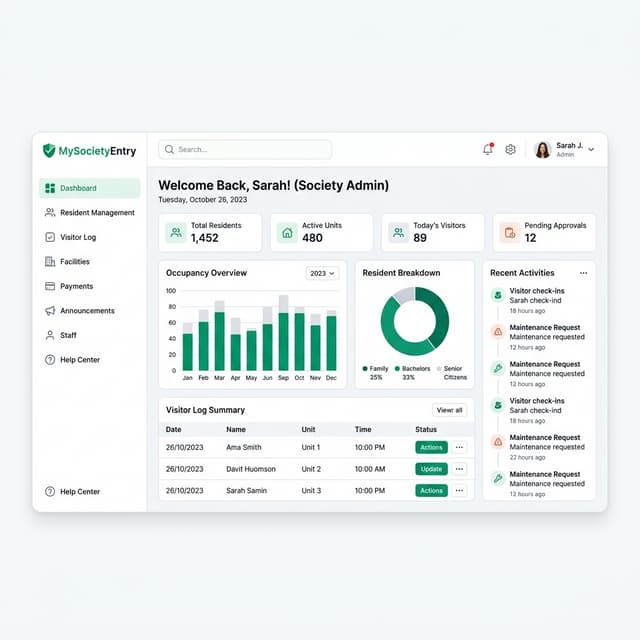
MySocietyEntry's parking management module keeps a structured vehicle registry tied to each flat, supports slot allocation across multiple zones and basement levels, and gives guards a way to verify vehicle ownership at the gate. Visitor parking is handled as its own workflow, so short-stay vehicles never get mixed up with resident-allocated bays, and the whole module stays connected to the rest of the society ERP — gate security, resident profiles, and operational reports.
Rolling out a digital parking system without disruption
- Start with a one-time audit: match every parked vehicle to a flat and registration number
- Migrate existing slot assignments before switching guards over to the new process
- Communicate the visitor parking rules clearly before enforcement begins
- Give guards a short trial period to get comfortable verifying vehicles digitally at the gate
Final takeaway
Parking disputes are rarely about the vehicles themselves — they are about the absence of a clear, enforceable record. A society that combines a documented policy with a connected vehicle registry and slot allocation system removes most of the ambiguity that turns a parking mix-up into a committee meeting agenda item.
See It In Action
Explore Parking Management System
MySocietyEntry helps committees turn guidance like this into a working process instead of another spreadsheet.
Parking Management System