
Domestic Staff and Tenant Police Verification for Housing Societies: A Practical Guide
Why police verification for domestic staff and tenants is one of the most inconsistently handled security requirements in Indian societies, and what a committee should keep on record to make it defensible.
Why police verification keeps getting handled inconsistently
Domestic staff and tenants are two of the highest-turnover groups a society deals with — cooks, maids, drivers, and nannies change households often, and rented flats change occupants every year or two. Most local police authorities expect verification for both, but the actual practice inside a society usually comes down to whoever is managing the gate that week. One flat asks its cook for a copy of an ID card. Another does nothing at all. A tenant moves in over a weekend and nobody circles back to check whether the landlord ever filed anything with the police. The requirement exists almost everywhere; consistent enforcement rarely does.
Where manual verification breaks down
- Verification is treated as the individual resident's responsibility, so the society has no visibility into who has actually completed it and who hasn't
- Staff ID copies, if collected at all, sit in a drawer or a WhatsApp chat rather than a searchable record tied to that person's gate access
- Tenant verification is assumed to be the landlord's job, and the society rarely confirms it was actually filed with the local police station
- There is no renewal or expiry tracking, so a verification done years ago is treated as still valid with no one checking
- When staff change employers within the same society, the new household rarely repeats verification, assuming the previous one still counts
- If an incident does occur, the society often cannot produce a clear record of who was verified, when, and by what process
What police verification actually involves
Requirements and the exact process vary by city and state, since verification is administered by local police stations or municipal e-verification portals rather than a single national system — several major cities now offer this online, others still require an in-person visit to the local station. What stays broadly consistent is the core documentation: identity proof, a recent photograph, the employer's or landlord's undertaking, and in most cases a verification receipt or certificate issued once the check is complete. Societies should always confirm the current process with their local police station rather than assume a format used elsewhere applies as-is.
What a defensible verification record needs
- A record of which staff members and tenants have completed verification, and which have not, visible to the committee rather than scattered across individual flats
- Copies of the ID proof and verification receipt or acknowledgment tied to that specific person, not a loose file with no clear owner
- A renewal reminder when a verification is due to be repeated, instead of assuming an old check still holds
- A clear link between verification status and gate access, so unverified staff aren't quietly granted the same standing access as verified ones
- A simple way for residents to submit or update a staff member's or tenant's verification documents without the committee having to chase paperwork by hand
Why this matters beyond the paperwork
A missing verification rarely causes a visible problem on an ordinary day — the staff member still shows up, still does the work, and nothing looks different at the gate. The gap only becomes a liability when an incident happens and the committee is asked what checks were actually in place beforehand. A society that can show a dated, documented verification process for its staff and tenants is in a materially stronger position than one that can only say residents were "supposed to" handle it themselves.
How MySocietyEntry helps
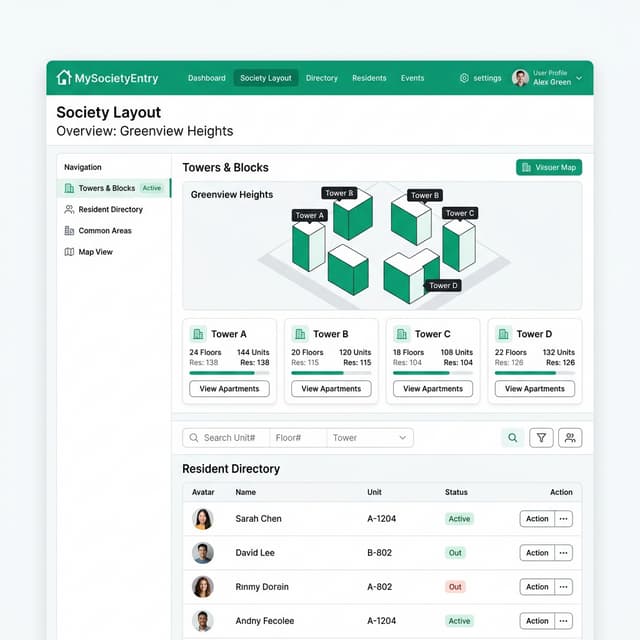
MySocietyEntry lets residents attach ID proof and verification documents directly to a staff member's or tenant's profile, so the record sits with that person rather than in a separate file the committee has to track down. Because staff and tenant records connect to the same gate access and visitor logs used for daily entry, the committee can see verification status alongside the person's actual access history instead of treating the two as unrelated records.
Final takeaway
Police verification is one of those requirements every society knows about but few enforce consistently, mostly because it has no natural owner once a resident is asked to "take care of it." A committee that keeps a visible, dated record of who has been verified — staff and tenants alike — turns a vague expectation into an actual, checkable security practice.